
|
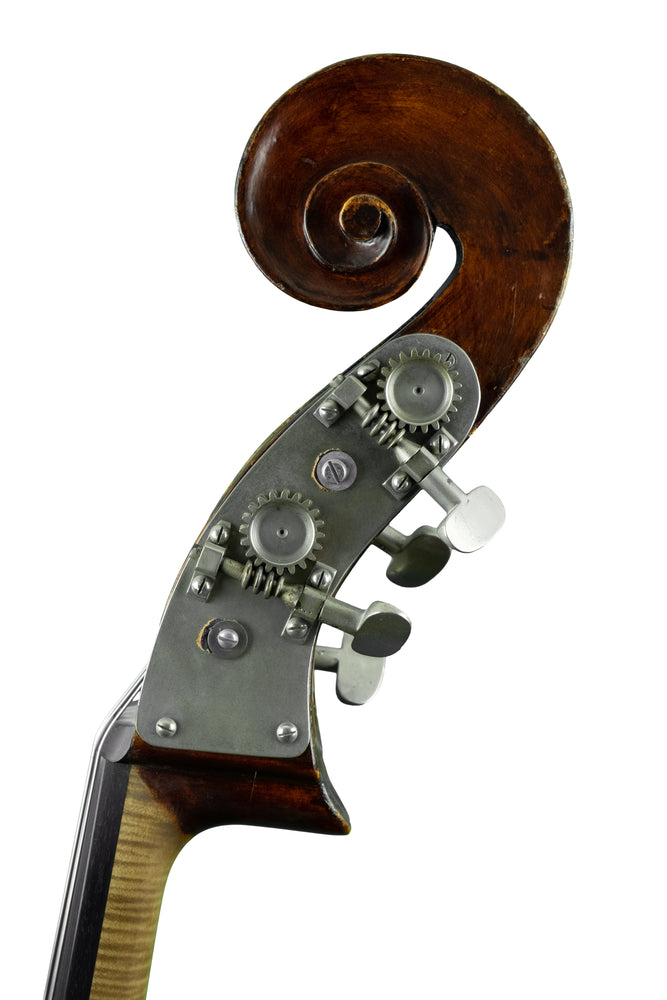
You definitely must come and try this great looking
instrument by Tom Nuttall. It ticks all of the boxes you mention
and many more.
The instrument bears the maker's original label
on the bass side of the inside back.
In size the label measures approximately 22cm in length and 4cm
across.
Yes - it is long enough to partially cover the central
brace and cover half the lower of two upper braces.
The label is printed in black ink and states, 'TOM
NUTTALL, MAKER & REPAIRER
OF, Violins, Violoncellos and Double Basses, 39 ROSE STREET (Manchester
Road) BOLTON.'
Yes - the instrument is branded 'T. NUTTALL' in
no less than four places on the central brace. One of the brands
is located close to the label - the other three are positioned
towards the middle of the back brace and form a triangle with the
letters facing inwards.
Good question. The answer is because all the original
materials and quality of work on the inside are consistent with
the same hand.
Most instrument makers use spruce or willow for
the internal blocks, linings and braces. On this instrument the
central brace, the one immediately above it, the bottom block and
all the linings are made from a hard wood - possibly mahogany.
Yes - the linings are made from three strips of
mahogany glued together to form a sort of laminate. The work certainly
isn't the neatest or the lightest that we have ever seen.
It is certainly a good line of thought.
We have seen images of a violin that bears a near
identical label and is stamped with his brand on both the upper
and lower outer back. This instrument is dated 1921 and is numbered
33.
Unfortunately Nuttall isn't recorded in any of our
violin maker dictionaries or reference books.
We have already established that Nuttall made a
violin in 1921. What we really wanted to try and find out is how
long he had been making instruments by that time. With a view to
try and establish his date of birth we took the liberty of looking
into some registers for the county of Lancashire.
The baptism records for the Wesleyan Methodist Church,
Egerton Street, Farnworh, Lancashire show that a Tom Nuttall was
born on the 16th May 1876 and that he was baptised at the church
on 20th Jan 1877. His parents were James & Sarah Nuttall who
lived at Spring Cottage, Moses Gate, Farnworth.
Yes - it is about 7 miles south of Bolton's town
centre.
In the marriage records for the town of Bolton it
is recorded that on the 11th April 1925 an Emma Nuttall aged 26
got married to a William Hughes aged 27 at the Holy Trinity Church,
Bolton, Lancashire. The records show that both Emma and William
lived at 39 Rose Street and that the bride's father was Thomas
Nuttall - a musician.
Yes correct. The dates and addresses all tie in
nicely.
Please click here to read Mr Hellewell's
extensive and most interesting research into the Nuttall family
history.
Yes - a big thank you is due to Mr Hellewell for
all his interest, time, effort and commitment.
I would have to say that the characteristics that
we tend to associate with Northern English instruments are present
in this instrument - it is just that they are a little more disguised
than we are used to seeing.
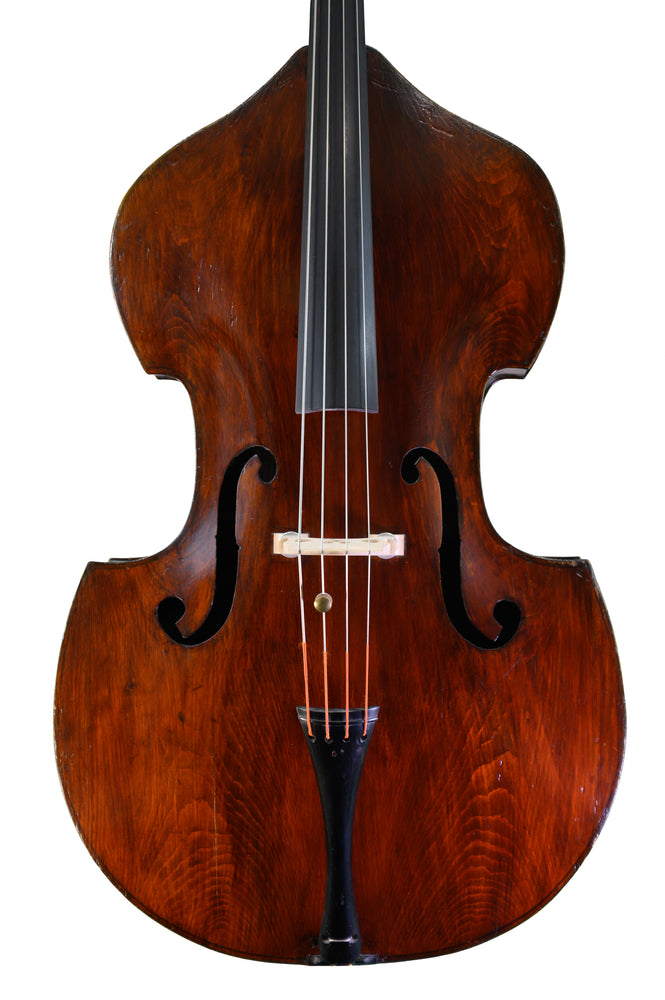
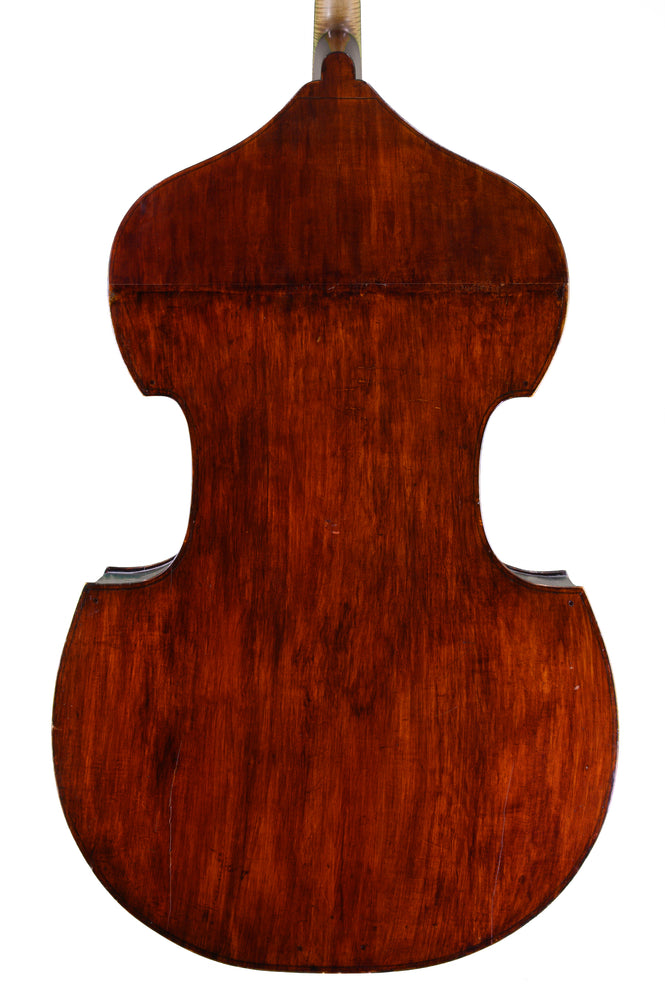
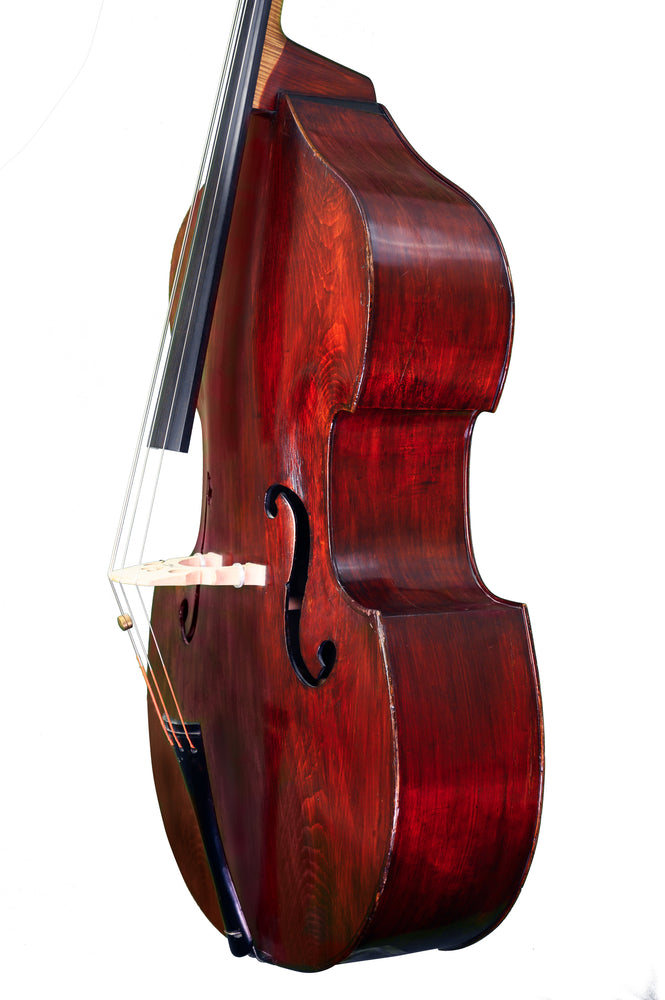
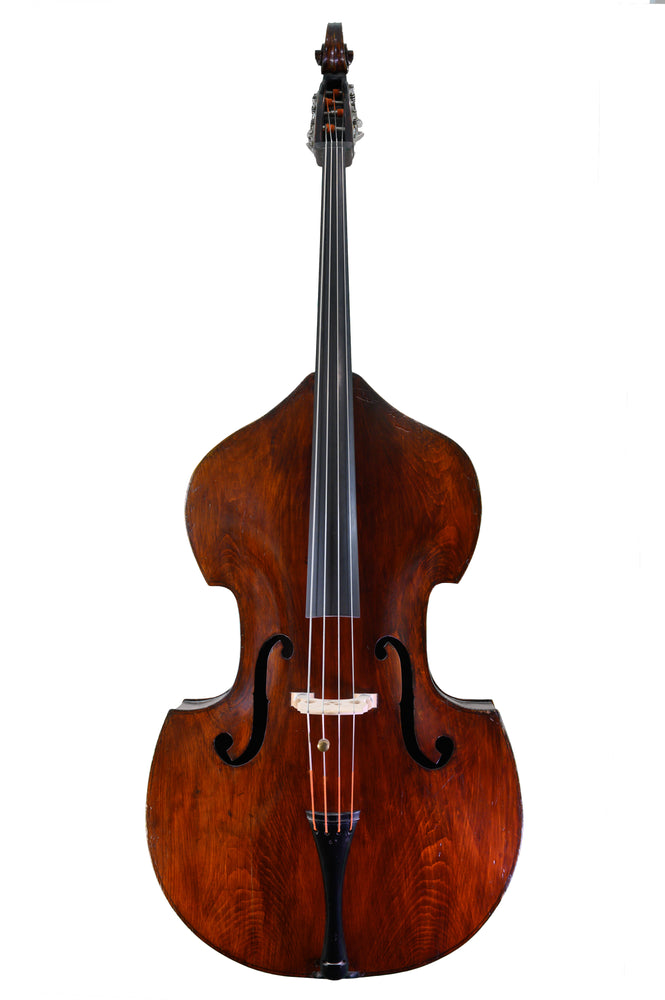
Well to start with the model is viol shaped and
has the flat back with angle break as we would expect from a Northern
English maker. What tends to confuse our eyes is the sort of squashed
outline and squareish lines - particularly in the centre bouts
of the instrument.
We have already mentioned that the wood used internally
is a little unconventional.
If you take a look at the wood that Nuttall has used for the front
of this instrument you will see that it has been cut on the "quarter" so
that the grain is shown as wide circular or elliptical lines rather
than narrow vertical lines.
Yes - this sort of wood selection would be pretty
unusual for any nineteenth or twentieth English maker.
Yes - they are certainly nice and generous in their
width and in the size of the lobes. There is something English
about them but at the same time there isn't an English feel about
them - if you know what I mean.
Yes - this is quite possible.
Apart from the fact that the upper part of the back
- from the angle break upwards was missing - not too bad.
Internally both the upper and lower back braces
have been replaced and any cracks have been washed out and restudded.
Yes. New "D" neck and fingerboard and first class set
up.
The small string length which measures only 105.1cm.
Wherever the inspiration came from to make this
subtle and distinctive instrument Tom Nuttall did a pretty decent
job of adopting and adapting it into his own unique and individual
style.
This really is a charming instrument with
Italianesque looks and a positive punchy type of sound. If you
are hoping to create a very special sort of image for yourself
this could well be the perfect partner for you.
LOB (length of back) - 108.4cm (42.65in)
Width across upper bouts - 54.4cm (21.45in)
Width across middle bouts - 35.3cm (13.85in)
Width across lower bouts - 68.0cm (26.75in)
Depth of lower ribs inc both plates - 20.5cm (8.15in)
Body Stop - 60.0cm (23.65in)
String length - 105.1cm (41.40in)
|