
Musical header Click here to discover some of the feedback our customers have given given us over the past few years. Click here to discover our articles in relation to the Double Bass Click here for our range of Double Bass specialist Books Click here for our quality Double Bass Accessories Click here for our quality Double Bass Bows Click here for our highest quality Double Basses over UK£20,000 Click here for our quality Double Basses up to UK£20,000 Click here for our range of Budget Double Basses up to UK £5000 Click here to review some of the instruments previously sold by The Contrabass Shoppe. Click here for the web site introduction Click here to discover more about The Contrabass Shoppe Click here for the outstanding Double Bass Gallery Click here for more information on our restoration work Click here to make contact with us
 

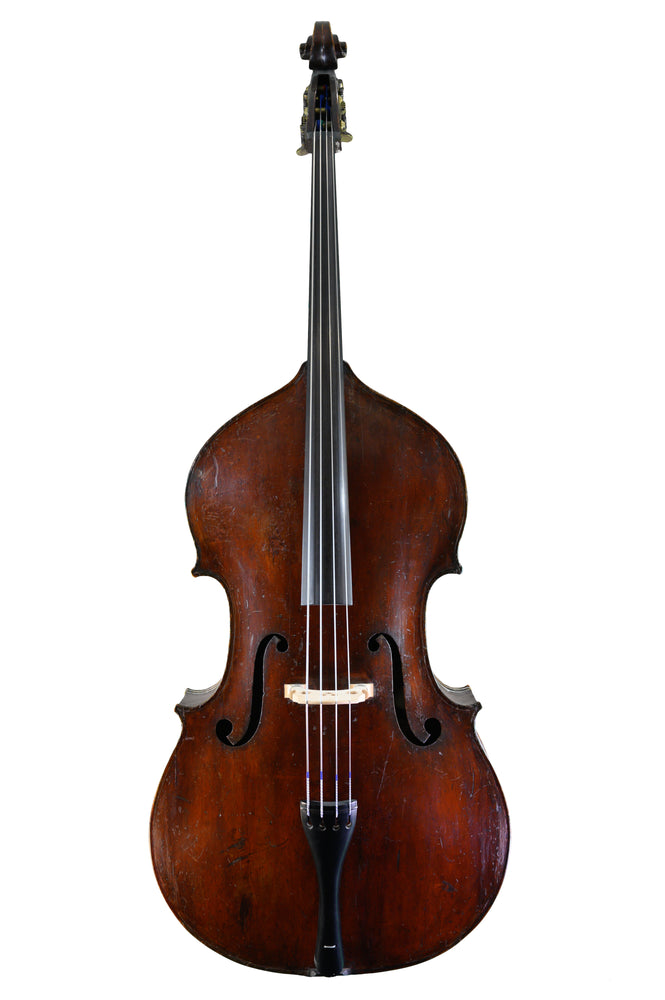
London Double Bass circa 1820 att Bernard Simon Fendt Jnr - #2350

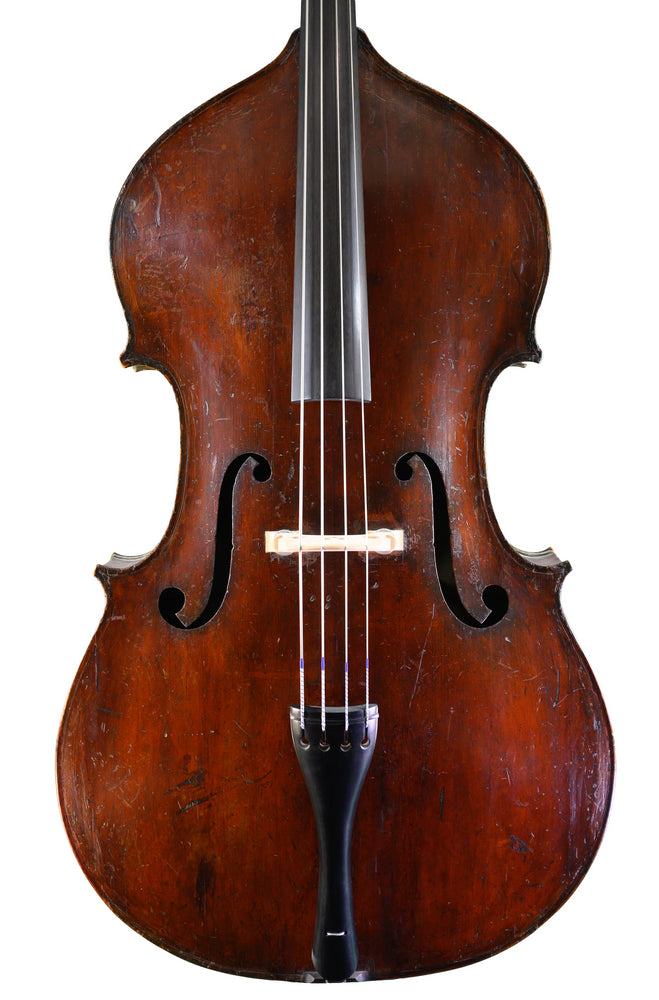
Front image of London Double Bass circa 1820 att Bernard Simon Fendt Jnr
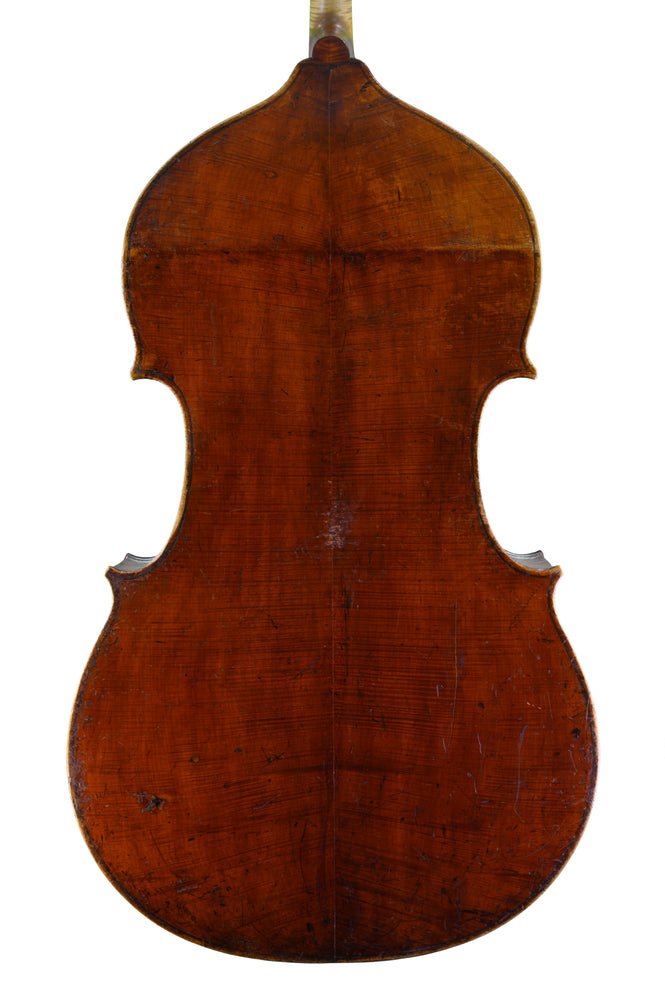
Back image of London Double Bass circa 1820 att Bernard Simon Fendt Jnr
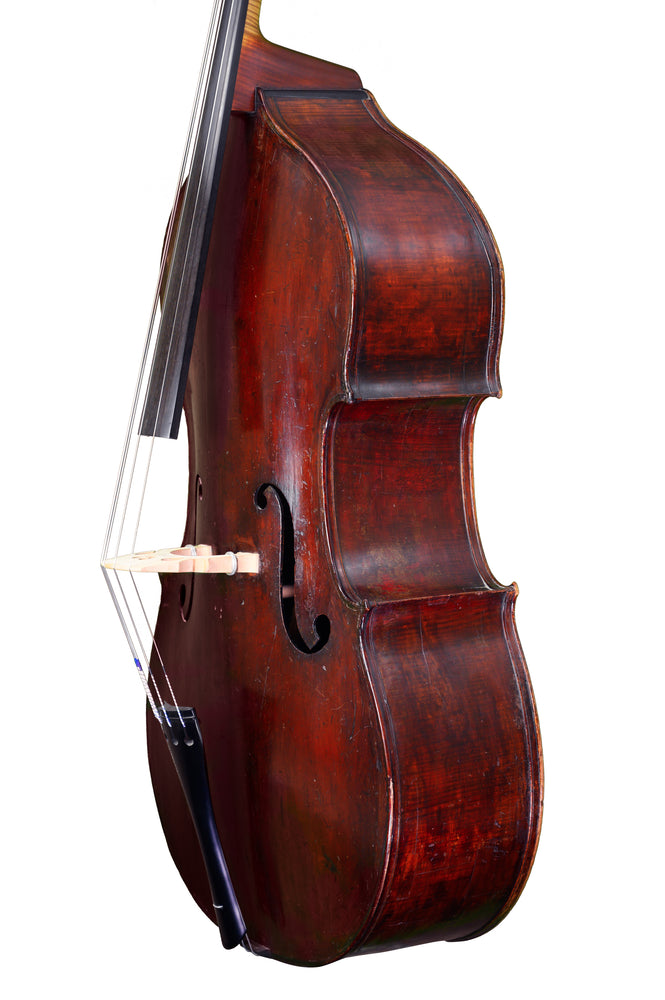
Side image of London Double Bass circa 1820 att Bernard Simon Fendt Jnr
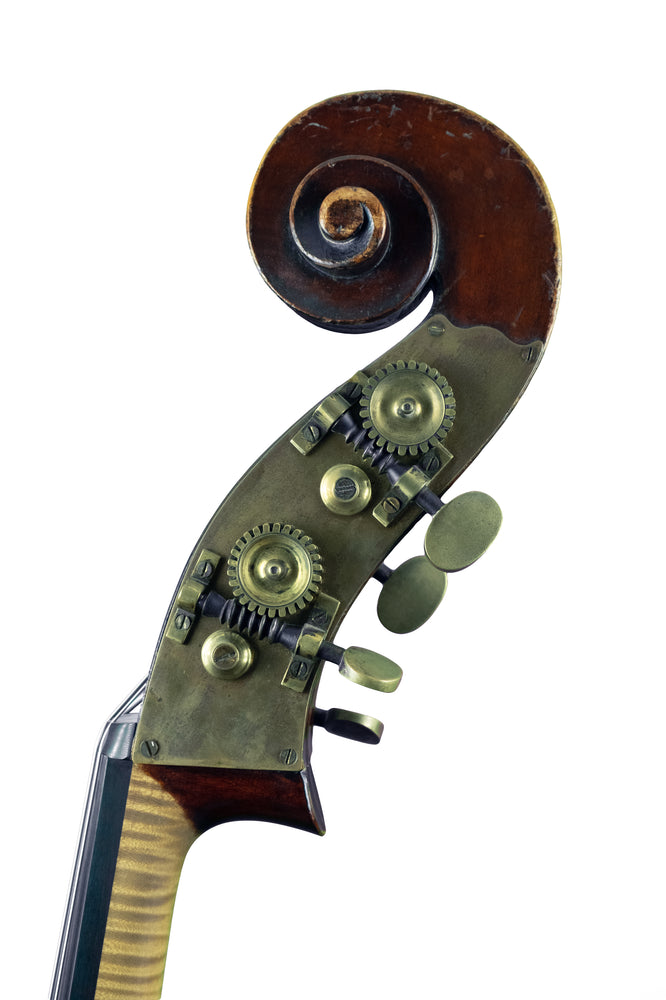
Scroll image of London Double Bass circa 1820 att Bernard Simon Fendt Jnr
Click to zoom to a double bass by Mario Bandini, Ravenna anno 1980

What a beautiful looking instrument this is.

Yes it is. The proportions and model are simply divine, the quality of wood used throughout is superb and the neatness of making is outstanding. As for the deep red-brown hues of the beautifully preserved varnish - well these are simply breathtaking.

Why have you only attributed it to Bernard Simon Fendt Jnr?

Because there are no maker's brands, internal labels or inscriptions on or in this exceptionally fine instrument - it becomes a matter of formulating an opinion based on the features of the instrument.

What can you establish from looking at the instrument?

Well - we know for sure that this instrument was made in London around the 1820's. We can deduce this much quite easily because of the model, the fine quality of the materials used, the fine workmanship throughout and the simply glorious "Fendt-red" varnish. They all shout out loud and clear that it is London making at its very highest level.

Where does identification become difficult then?

The instrument displays features that aren't quite typical of the main London makers of the time. The model in particular is more "Amatise" in its arching and it is slightly smaller than the Classic Lott, Fendt, Kennedy, Betts or Hart instruments. In addition there is the use of outside linings that suggest influence from the earlier side of the nineteenth century with makers such as Hill, Corsby and Dodd.

What aspects are you going to consider?

All aspect of the making will be examined. Of particular interest is the model, the workmanship, the placement and cut of the F-holes, the use of outside linings and the form and execution of the scroll. In addition an attempt at placing the instrument in a historical context will be necessary in order to support our theories.

In terms of bass making what happened - historically - in the early 19th century?

The "Great Age" of Double Bass making in England can be traced back to the move to London in 1794 by the Venetian bassist - Domenico Dragonetti. Besides being a virtuoso player Dragonetti was a collector of fine instruments and imported many double basses into the country. The blossoming of the musical scene fuelled a demand for the creation of theatres, concert halls and societies in every town and city which in turn created a demand for more musicians. With only a short supply of old instruments, players began to source their instruments from the modern makers of the day and a thriving industry emerged.

Didn't some foreign makers come over to England to help meet the surge in demand for new instruments?

Yes - that is right. The Lott and Fendt families came over from Germany and Vincenzo Panormo came over from Italy via Paris in about 1791. All the makers were to have an enormous impact on the British violin making scene.

Tell me a little about John Frederick Lott Senior.

Baptism records show that John Lott 1 (1776-1853) was born in London rather than the usually described Gottingen in Germany. He became acquainted with Bernard Simon Fendt 1 (1769 - 1832) who helped him obtain a position making cellos and basses in the shop of the violin dealer and maker Thomas Dodd (1764 - 1834). Both started working for Dodd in 1798. Lott Snr was to remain with Dodd until Dodd died in 1834 while Fendt Snr was to stay for eleven years (1809) after which he departed to work in the shop of John Betts.
It is probable that Fendt Snr was responsible for instructing Lott Snr.

Tell me a little about John Frederick Lott Junior.

At around the age of 14 - after learning the basic skills of violin making from his father - John Frederick Lott Jnr (1804- 1870) became apprenticed at the shop of Richard Davis (formerly the shop of John Norris and Robert Barnes) where he worked alongside his older brother - George Frederick Lott. There are two different accounts as to how long Lott Jnr stayed with Davis. The first account puts it at four years while the second puts it at only a year. Whichever case - it does appear that he obtained wood and tools from Dodd - where his father worked - to make instrument - selling the finished instruments through Dodd and Metlzer until about 1823 when disillusioned with his way of life he gave it up for "twenty years of colourful travel" which are documented in the semi-biographical novel "Jack of all Trades" - written in 1858 by his friend the violin connoisseur Charles Reade. Lott Jnr finally returned to London in the early 1840's. In 1852 he established his own shop at 60 Wardour Street where he developed the art of copying old master instruments to a very high level.

Tell me a little about Bernard Simon Fendt 1 (Senior)

Bernard Simon Fendt I was born in the Bavarian town of Füssen on 9th May 1796 and died in London on 15th November 1832. Fendt Snr moved to London in 1798 and joined the shop of Thomas Dodd where he remained for eleven years. In 1809 Fendt I joined John Betts where he remained as workshop foreman for fourteen years.

Tell me a little about Bernard Simon Fendt 11 (Junior)

Bernard Simon Fendt II (often referred to as Junior) was the eldest son of Bernard Simon Fendt 1. He was born in 1801 and was also employed in the workshop of John Betts - where, no doubt he was taught by his father. He remained in the Betts shop until at least 1823. Around 1831 he became partners with Charles Joseph Farn. In September 1832 - after Farn's death he joined George Purdy. Fendt Jnr died of tuberculosis on March 3rd 1852.

Tell me a little about Thomas Dodd.

Thomas Dodd was born in 1764. By 1794 he had established a shop in Covent Garden and in 1798 he employed Bernard Simon Fendt Snr and John Frederick Lott Snr. His activities included making copies of master instrument, importing, reassembling and fabricating Italian instruments with adaption's and alterations so as to deceive. Whilst in Dodd's employ Fendt and Lott produced many fine double basses. Dodd died in 1834.

Why have you gone on so much about both Lotts, both Fendts and Dodd?

Well - this is because they were all so closely linked together that in many cases it is difficult to separate their work. In many instances - in order to fulfil orders or demand - the shops, dealers and makers both commissioned and undertook bits and pieces of work for each other. With regard Lott Jnr's basses - although they do differ in some ways from those of his father - they are sufficiently similar in others to be confusing. Similarly it is often difficult to distinguish between the instruments of Fendt Snr and Fendt Jnr. Add in the influence of Thomas Dodd or John Betts to the equation and you start to see why the picture becomes blurred.

Have you considered any other London makers?

Yes - as mentioned previously there was a lot happening in the instrument trade in London at this time. The following makers have also been considered:

1) John Devereux's (1810- 1883) name was suggested because it is said that he trained in the workshop of Fendt Jnr before emigrating to Melbourne, Australia in 1854.
2)John Furber (1780 - after 1857) and his son Henry John Furber (1809 - 1891) both of whom worked for the businessman Arthur Betts (1775 - 1847) have been suggested and considered.
3) John Thomas Hart (1805-1871) who was a maker, dealer and connoisseur of instruments.

The instrument inside - during repairsAre there any repair labels that establish anything?

There is an old repair label positioned on the bass side of the central back brace which reads 'Repaired by E. Withers and Co, 31 Coventry Street, London'. Although it doesn't help us in our quest for authenticity it does establish that the repair was undertaken sometime between 1846 and 1878 when the Withers shop was located at this address. The shop being the same one in which John Lott Jnr had worked when it had been in the ownership of Richard Davis.

I can appreciate that the task of examining and documenting the stylistic traits of each maker mentioned above in relationship to this instrument would be a considerable undertaking. What conclusion did you reach?

On balance and after careful consideration of each makers work we would have to say that the Bernard Simon Fendt Jnr attribution is not unfounded.

While doing research on the instrument did you consider the opinions of anybody else?

Yes - we received a lot of useful ideas and inputs from several well established and knowledgeable double bass dealers and makers. We thank them very much for their time and contributions.

What sources have you consulted in studying and writing about this instrument?

The listing is not complete but here are the main sources:

    1. The British Violin - published by the British Violin Making Association in 2000 (ISBN 0 953471 27) is full of wonderful photographs and concise information on the English instruments and their makers that were exhibited at the Royal Academy of Music, London during 1998.
    2. Edward Withers Ltd - 230 years of Violin Craft in Soho by Adam Whone. Published in 1996 by Mill Hill Publications (ISBN 0 9529264 07)
    3. Universal Dictionary of Violin & Bow Makers by William Henley. Published by Amati Publishing Ltd 1973
    4. Domenico Dragonetti In England (1794-1846) by Fiona Palmer. Published in 1997 by Clarendon Press, Oxford (ISBN 0 19 816591 9)
    5. The Strad - February 1995 - Article about a classic bass by John Lott Snr entitled "King of the Double Bass" -by Thomas Martin
    6. The Strad - February 1997 - Article about Bernard Simon Fendt Jnr entitled "Double Vision" by Thomas Martin and Martin Lawrence.
    7. The Strad - July 1997 - Article about the basses of Thomas Dodd entitled "From Brewer to Bass Innovator" - by Thomas Martin.
    8. The Strad - July 1998 - Article on the basses of Hart & Sons entitled "Hybrid at Heart" by Thomas Martin and Martin Lawrence.
    9. The Stad - January 2000 - Article about John Lott Jnr's talents entitled" Bass Behaviour" -by Martin Lawrence and Thomas Martin.
    10. The Strad July 2004 - Article about John Devereux entitled "Making it Down Under" by Alan Coggins and Michael Lea.
    11. Double Bassist Number 26 - Autumn 2003 - Article about Bernard Simon Fendt Jnr entitled "London Pride" by Stefan Krattenmacher.

In brief - what are the salient features that swing the attribution in favour of the Fendt Jnr?

The instruments produced by both Fendt Snr and Fendt Jnr are consistently of a very high standard and both makers had the ability to turn their hand to any pattern or style of work required. With regard to this instrument it is the superb quality of wood that has been used throughout, the general proportions, the uprightness of the F's and the incredibly neat, strong and bold making that is more suggestive of Fendt Jnr. The head too is reminiscent of Fendt Jnr. The scroll is bold and well-carved, there is a slight flatness around the volutes of the scroll and the peg-box is fairly short. The rich red-brown varnish is also characteristic of Fendt Jnr. The particularly neat use of the outside lining is evidence of the strong links with Thomas Dodd.

That's a fair bit of research material to consider and evaluate. Does the instrument sound as good as it looks?

Yes it does. We are pleased to say that the instrument comes complete with the glorious full-bodied quality of sound that is associated with fine English instruments.

Time for a quick final summary.

This instrument has a great many wonderful qualities that should figure highly on the wanted-list of any prospective customer. The timber used in its construction is beautifully figured, the proportions are perfect for every type of player, the instrument is structurally in exceptional condition and the quality of sound that it produces is full and tonally-rich. With nineteenth century London made instruments of this sort of quality and in this sort of condition now in demand more than at any other period previously - we firmly believe that this instrument will land its new owner a top position in a major city and prove in time to be wonderful investment.

Stats:
LOB (length of back) - 114.8cm (45.15in)
Width across upper bouts - 53.0cm (20.85in)
Width across middle bouts - 38.0cm (14.98in)
Width across lower bouts - 67.4cm (26.50in)
Depth of lower ribs inc both plates- 22.8cm (8.95in)
Body Stop - 61.2cm (24.10in)
String length - 106.4cm (41.85in)

Price on application.

For a very big view of the instrument, click on each of the photographs

Front View

Back View

Front View Back View

Quarter View

Scroll view
Quarter View

Scroll View

Click here for a full view of this instrument
Back to the Top Quality Double Bass Section
Back to top
Contrabass Shoppe footer Click here to review some of the instruments previously sold by The Contrabass Shoppe Click here for our range of Budget Double Basses up to UK £5000 Click here for our quality Double Basses up to UK£20,000 Click here for our highest quality Double Basses over UK£20,000 Click here for our quality Double Bass Bows Click here for our quality Double Bass Accessories Click here for our range of Double Bass specialist Books Click here for the web site introduction Click here to discover more about The Contrabass Shoppe Click here for the outstanding Double Bass Gallery Click here to discover our articles in relation to the Double Bass Click here for more information on our restoration work Click here to make contact with us Click here to make contact with us Click here to email us.