
|
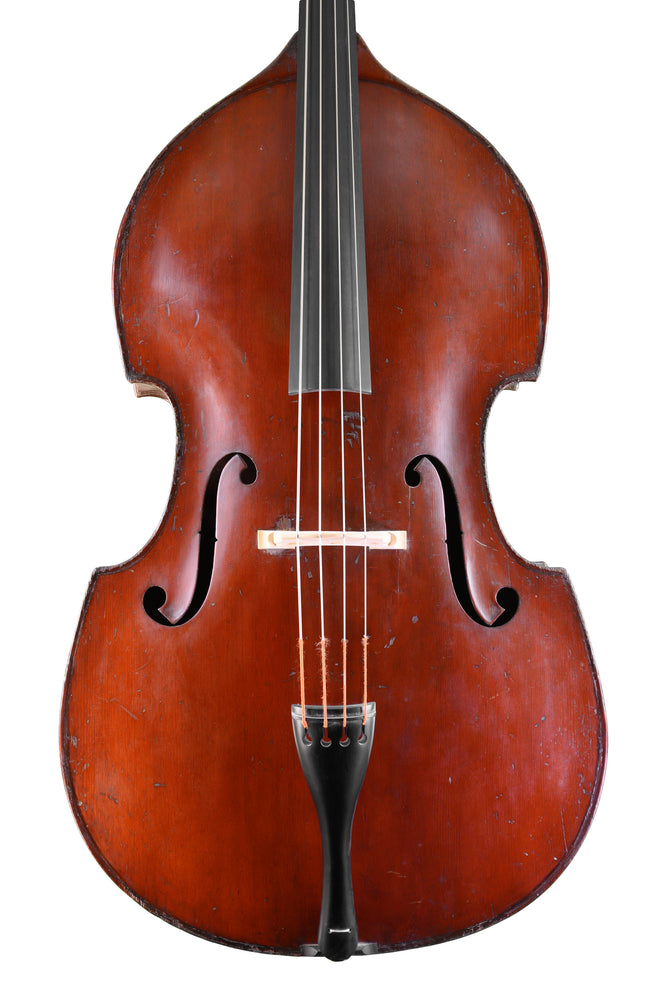
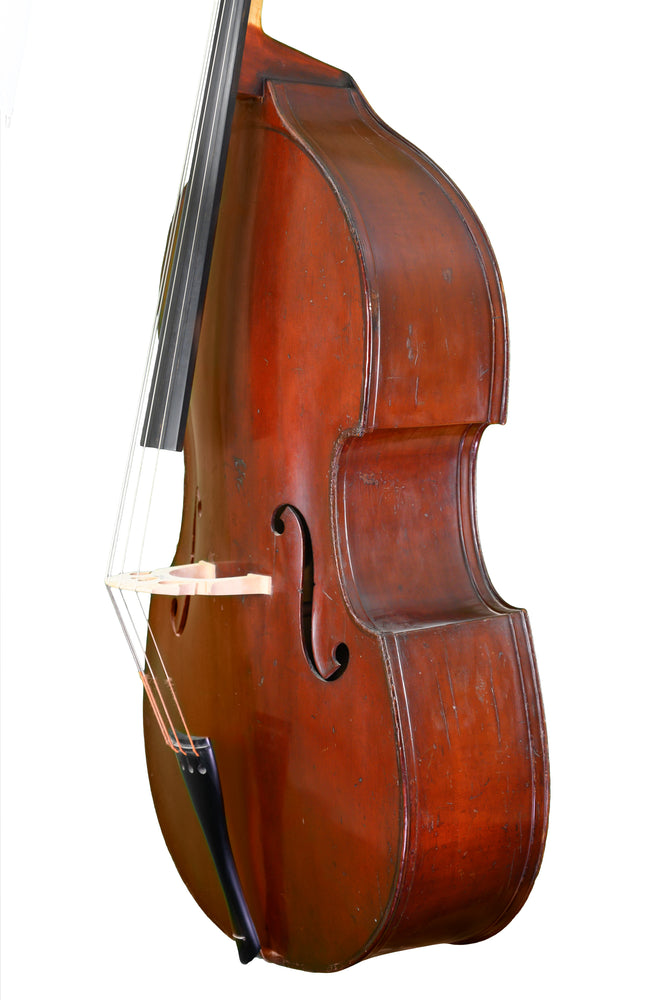
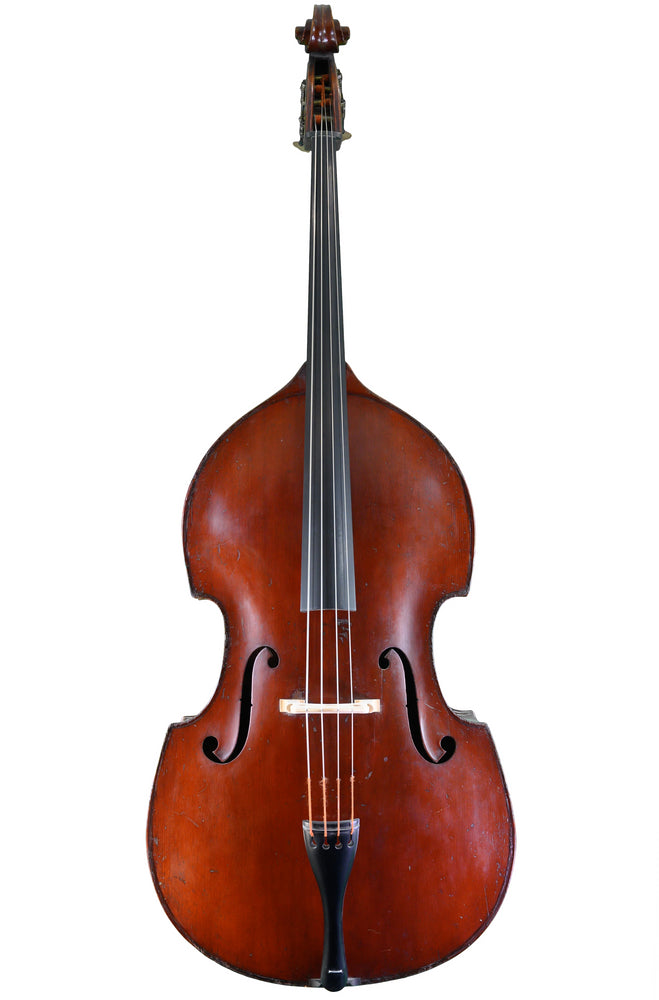
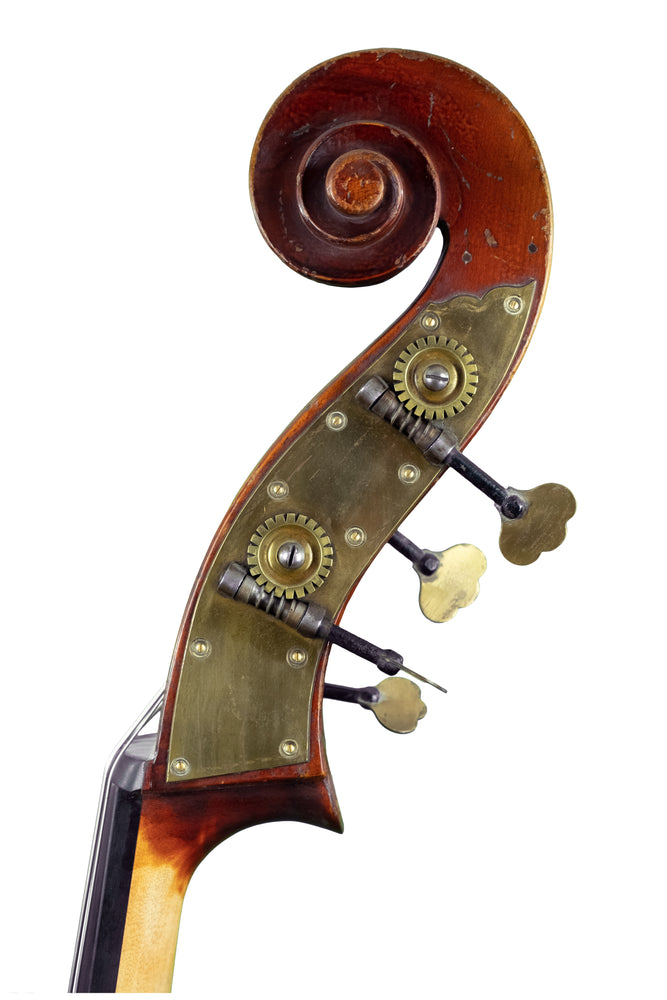
The model and making of this stunning violin outline instrument was directly influenced by the Giovanni Paolo Maggini double bass that was and still is housed (April 2012) at the Royal Opera, Stockholm, Sweden.
Johannes Wilhelm Adam Hegner (b-1852, d-1938) was the principal double bass player of the Orchestra of the Swedish Royal Opera between 1876 and 1907. In 1903 he commissioned this double bass directly from Alfred Nilsson Brock. It is the only double bass that Brock made.
Information about Brock and this instrument is recorded in a book dedicated to the ten plus instruments of the Royal Opera.
"Kungliga Operans kontrabasar och basister" (Kungliga Operan 2001, ISBN 91-86260-35-9) was written by Börje
Ljungkvist - a long serving member of the opera orchestra.
According to the orchestra's database (April 2012) Börje was a member
from 1964 - 2002.
It translates to "The Royal Opera's double basses and bassists". In 1994 Börje became the curator of the Royal Opera's double basses and cellos. After initial study and documentation of the instruments he received a scholarship from the Björnska Fund and one from the affiliated trade union organization TCO (Tjänstemännens
Centralorganisation. In English - The Swedish Confederation of Professional
Employees) to further research the instruments.
Yes - the Kungliga Hovkapellet (Orchestra of the Royal Opera) dates back to
1526 and is recognised as one of the oldest orchestras in Europe. In 2001
Börje's dedicated research culminated in "Kungliga Operans kontrabasar och basister" being
published to coincide with the Orchestra's 475 year anniversary celebrations.
Only a very limited number of copies were produced - now sadly unavailable.
We were fortunate to be gifted the book by Luin Sitkey - a maker, repairer and dealer of instruments in Stockholm.
It is written in Swedish.
On pages 68 and 69 there is a listing entitled "Operans instrumentmakare genom tiderna" or in English "Opera instrument makers throughout the ages".
The listing dates back to the beginning of the eighteenth century.
At the top of page 69 the entry provides the following information: "Alfred Brock (b-1876, d-1935) Luthier. He opened a shop in Stockholm in 1900. He began as a violin maker but became internationally recognized as a lute maker. In 1903 he built a double bass modelled after Maggini. The instrument is currently at the Music High School (Musikhögskolan)
in Stockholm."
Once again our thanks go to Luin Sitkey.
Yes. On pages 38 and 39 there is a most intriguing listing entitled "Reparationer av Operans basar" or in English "Repairs to the Opera's basses".
The repair work undertaken on each instrument is catalogued against the name of the repairer, the month and year that the work took place and the amount that the work cost.
Yes. In August 1907 he performed some work on the instrument that cost 20 Swedish
kronor. Exactly four years later - in August 1911 he did what is documented
as a "Stor rep." - "Large repair." - that cost 25 Swedish kronor.
Yes. It is documented that he worked on a bass by Osignerad Tysk three times,
a bass by Johann Öhberg three times and a bass by Barbé just
the once.
The earliest entry recorded in the book is the one done on the Maggini dated
August 1907. The last entry is for some minor regluing work on the Öhberg
which is dated November 1924.
Very little. The monumental Universal Dictionary of Violin & Bow Makers by William Henley (Amati Publishing 1973) literally only has a two line entry as follows; "Born
1876. Maker to the Court and Conservatorium at Stockholm, 1915. Died 1935.
Lutes, viols and violins of very refined workmanship."
The Contrabass Shoppe Ltd purchased the "Hegner" from some Hungarian wood and
instrument traders on the 1st February 2005.
No - not at all. The instrument's form and making characteristics didn’t
look like anything else that we had seen before and there were no maker's labels
or inscriptions that we could see on the inside.
The traders were trying to pass the instrument off as a real Giovanni Paolo Maggini (b-1580, d-1630/1).
Correct. It was quite apparent that this instrument didn’t date from
circa 1600.
As per usual - it was based on the quality and condition of an instrument.
Agreed.
It was by pure coincidence that our maker and repairer friend - Luin Sitkey
- already mentioned - was passing through London a few weeks after I had
purchased the instrument. I already knew that Luin had in the past purchased
instruments of Hungarian or Romanian origin and although I had already
sent the "Hegner" to one of our outworkers - I mentioned to Luin that I
had purchased such an instrument.
To my amazement Luin revealed that only one month earlier he had exchanged the instrument for a number of modern instruments from the exact same Hungarians that I had purchased it from.
Luin looked surprised that I needed to ask this question. He retorted - "It has Brock's original label on the inside".
Well it was definitely the same instrument. Sadly the Hungarian traders had removed the label in the hope that they could fool somebody into thinking it was a real Maggini.
Yes - what is even worse is the fact that when we tried to recover the label from the traders we learnt that in the process of removal - it had been destroyed.
Luin confirmed that he had acquired the instrument directly from the "Music High School" and that when he got it - "It was in a very bad condition".
Luin - "Probably 15 months".
Luin - "In the early 1980's the bass was owned by a bass player called Thomas Östergren. Prior to him emigrating to the USA Östergren sold the instrument to the Music High School. Over a period of years it fell badly into a state of disrepair and became unplayable - so in preference to funding a lengthy restoration project they accepted a trade with me for a French instrument that was in good playing order".
Hi, I was reading about the Swedish Maggini bass and found the following
quote: "He even built a double bass after Maggini model signed 1903 which is nowadays at the Music High School in Stockholm". It should actually be the "Royal College of Music" not the Music High School. If you translate the Swedish word for college (högskolan) to English literally it would be high school, a common mistake. How do I know this? For one there is no school named the "Music High School" in Stockholm. And two, I am currently a student at the Royal College of Music. Hope that you have use of this information and I hope this wonderful bass finds its way back home to Sweden again some day. All the best! Magnus Nygårds.
It is called "Kungliga Musikhögskolan i Stockholm" or the "KMH" in abbreviated
form. The college dates back to 1771 and is the oldest institution of higher
music education in Sweden.
Yes. Luin is a naturalised Swedish citizen. Born in Budapest he moved to Sweden in 1971.
Affirmative.
The Brock bass was made for a Johannes Hegner, born in Copenhagen 1852 almost at the same time as Ludwig Hegner (b-1851, d-1923), a Danish double bass player with a certain reputation. They are not related though; I've checked with the Museum of Music in Copenhagen.
Johannes Hegner was principal bass in the Royal Opera in Stockholm between
1876 and 1907. That means that he had the same position as I have today
and that he played on "my" Maggini. Obviously he wanted Brock to make something
similar to the Maggini but you should know that he did not make a copy
of it. I have seen the Brock bass and I would say it has strong influences
but it is smaller and doesn't have the same proportions. It is very probable
that Hegner thought that the Maggini was too big.
In Brock's notes the bass has number 24. When he died in 1935 he had made 893
instruments but only one bass. The bass is dated to 30/03/1903 and he sold
it for 100 Swedish kronor. There is another note from a later date that
the bass needed some modifications (Förändring +75=) that added
another 75 kronor to the price. Almost a second bass in price!
After Hegner died in 1938 the fate of the bass is not clear, but eventually it came into the possession of Knut Gullbrandsson, also principal bass in the Opera. A great player and teacher. After that Thorvald Fredin, my teacher and former colleague bought it. I'm not sure of the players name who sold it to the Royal College of Music in Stockholm. Then one of the teachers made a trade with Luin Sitkey. The rest you know.
Yes the e-mail was accompanied be three jpg files containing the following images:
1) An excerpt from Brock's "tillverkningsbok" (order book).
2) An 85th birthday tribute to Johannes Hegner.
3) An announcement of Johannes Hegner's death.
At the time there were other projects to take care of so I thanked Michael
for his interest and support and simply kept the information on file. It
was only after receiving the feedback from Magnus Nygårds that my
interest in the history of the instrument was reignited.
Yes. I wanted some help in translating the 85th birthday tribute and the information on the announcement of death. With copyright in mind I also wanted to know where Michael had obtained the three images.
The birthday tribute first appeared in Musikern 1937 nr 23. Musikern is the
name of a news magazine for musicians that was and still is (April 2012)
published by the Swedish musician's union "Musikerförbundet".
On the 15/12 the chamber musician Johannes Hegner, Stockholm will celebrate
his 85th birthday. Born in Copenhagen in 1852 he studied music with the
great violinist and teacher Lars Valdemar Tofte. At the age of 17 Hegner
moved to Stockholm where he was employed to play bass in Blanch's café (a
restaurant) under the well known bandleader George Lundbye. After that
he played in the orchestra of the restaurant Berns Salonger led by August
Meissner. From Berns - Hegner went to the Royal Theatre (the Royal
Opera) and was employed there from the 1st July 1876. In December 1907
he resigned from the Hovkapellet (orchestra) after many years
as principal double bass.
Hegner has been a member of the union since its foundation and has reached
an imposing age. He is currently the union's second oldest member. During
his many years of playing in our capital he has gained numerous friends,
a large number of whom are sure to be invited to celebrate with him at
his home, Älvkarleövägen 18, Hjorthagen, Stockholm.
Svenska Musikerförbundet and Musikern wishes him all the best for his
85th birthday celebration! C.G.
Our beloved husband and father
former chamber musician
Johannes Hegner
Born in Copenhagen the 15th December 1852.
Departed from us the 3rd June 1938
at 6.15am.
Missed by relatives and many friends.
Augusta Hegner, Anton and Rut Hegner, Frans and Ella Hegner,
Sigrid and Herman Forssman born Hegner, Grandchildren.
The ceremony will take place on Thursday 9th June 1938 at 5pm
in the North Crematorium where flowers will be received before 4pm.
This is the only notification.
Michael Karlsson; The funeral ceremony took place in "Norra Krematoriet" a
crematorium and major cemetery just to the North of Stockholm in the municipality
of Solna.
Michael Karlsson; I got them from Börje Ljungkvist.
Börje's reply was in Swedish. A rough translation is as follows; Hey Tony!
I'm sending you some of my correspondence with Hans Riben at the Music Museum
in Stockholm.
What I know about the Brock bass I have been told by Hans. If you want more
information on the Brock contact Hans directly at the museum. I am certain
that he will help you. He is a really nice person. Bass Greetings - Börje.
On the 16th September 2005 Börje wrote; Hi Hans! I just heard that
the Brock bass was in London. Check out the link. Do you know anything about
the Brock bass? Was it ordered by the Hovkapellet etc? The museum has Brock's
notebook. Maybe you can find something interesting there? Bass Greetings -
Börje.
Hi Börje. This is interesting news! After a look in Brock's manufactory
notebook I see that he made only one doublebass (if you don't count a miniature
he gave to our museum in 1908). This only doublebass is dated the 30/03/1903
and has production number one (among the doublebasses) and 24 (in his entire
production). It was ordered by J.W.A.Hegner and the price was 100 sek. There
is also a pencil note that the instrument had to be modified and that increased
the price with another 75 sek. I have scanned this page in the notebook and
enclose it as a jpg file (Tillverkningsbok.jpg).
This means that the doublebass is an early opus in Brock's production. When he died in 1935 he had made 893 instruments, most of them lutes. In one sense the doublebass is of course unique, but on the other hand it's not at all typical for his production so the museum is not going to buy it.
Who might the buyer, J.W.A. Hegner have been? Well, you probably know already,
but I did a search for some articles and found that Johannes Hegner (1852-1938)
was an important person in the music world in Stockholm with over 30 years
in the Hovkapellet (Orchestra of the Royal Opera). I enclose the
articles (Klipp Hegner 85 år.jpg and Klipp Hegners dödsannons.jpg). Best
regards! Hans.
Yes indeed. I needed to find out who was the copyright holder or holders of the original documents and of the three jpg files. My questions to Hans were as follows;
1) Does the Museum hold the original documents?
2) Did you take the jpg images yourself from the originals?
3) Do I need the Museum's permission or your permission to use these images in my review of the Brock on my web site?
I received a same day (13th April 2012) response as follows;
Dear Mr Houska.
Thank you for your interest in the instrument maker Alfred Nilsson Brock. He is best known for his more than 700 lutes, but he also made a number of other instruments.
It is true that the documents stem from our museum. Since the time I sent them
to Mr. Börje Ljungkvist this part of our collections have been handed
over to The Music and Theatre Library of Sweden (Musik-och teaterbiblioteket),
www.muslib.se The library and the museum are both parts of the organization
Music Development and Heritage Sweden (Statens musikverk).
The answers to your questions are thus:
1) The originals belong to The Music and Theatre Library of Sweden.
2) Yes, I have taken the jpg photos of the originals.
3) Please feel free to publish the images on your website, but refer to The Music and Theatre Library of Sweden as owner of the originals.
With kind regards
Hans-Martin Riben
Museum Director
Stockholm Music and Theatre Museum
Box 16326, SE-103 26 Stockholm, Sweden
Visiting address Sibyllegatan 2
Websites www.musikochteatermuseet.se / www.statensmusikverk.se
Yes indeed. In the one reply ownership of all three original documents had been established and permission to publish all three had been granted.
Yes as follows;
1) The announcement of Hegner's death - what form is it in? Is it a poster
or does it come from a newspaper?
2) Would you describe or translate Brock's "tillverkningsbok" as his order
book or notebook or other?
3) Would you object if I were to use an English translation of some of the
information regarding Brock's tillverkningsbok and Hegner that you sent to
Börje
in an E-mail dated 16th September 2005? The three images that you took were
attached to this email.
1) It's an announcement printed in a newspaper (which one is however not known).
2) Brock's "tillverkningsbok" is an order book in the form of a small notebook.
3) Please use the information as you like it.
Yes indeed he is. A respectful thank you Hans-Martin Riben.
At this point it seemed that my research was drawing to a close. Well it was - that is until Michael Karlsson dropped me another e-mail.
By the way, did I mention that Brock is from the same family as Bengt Nilsson
(b-1926, d-2009) the Swedish violin maker who wrote the books Svensk Fiolbyggarkonst
(Swedish Violin Making. Pub by N. Nilsson Fiolbyggare AB in 1988. ISBN
91-7970-354-2) and Johann Öhbergs Violoncelli (Johann Öhberg's Cellos. Pub by N. Nilsson Fiolbyggare AB in 2002. ISBN 91-631-2639-7). Bengt's son Roland now runs the workshop in Malmö.
He has a web site as follows; www.fioler.se
The following is reproduced with the kind permission of Roland Nilsson the current owner and managing director of N. Nilsson Fiolbyggare AB (N. Nilsson Violinmaker Ltd);
The founder of the company Nils Nilsson was born in Virestad in 1842. As
a teenager Nils made several guitars and when in 1888 he dared to turn his
hobby into a profession he had already produced a considerable number of
instruments. He established his workshop on the top floor at Torpgatan
in Malmö.
Three sons, Alfred, Gottfrid and Albert chose to follow in their father's footsteps. Alfred who took the name Brock, became a famous lute maker and purveyor to His Majesty the King in Stockholm. Gottfrid and Albert continued working with their father at Torpgatan. When Nils Nilsson died in 1929 aged 87 - Gottfrid had already taken over the firm. Later even Gottfrid's son Bengt started working in the firm and it was he who in turn took over the business when Gottfrid died suddenly in 1952.
In addition to the manufacture of bowed instruments - during Nils's era - lutes, guitars, citterns, mandolins, zithers, harmoniums and different historical instruments were produced. Many of these are now in museums. During the 1920's and 30's the company made many stringed instruments of the very highest quality. The popular folk music revival of the 40's provided a strong demand for the manufacture of lutes and guitars.
In 1972 the workshop moved to Eriklustvägen 62 where the business was
driven forward with the production of stringed instruments. Today (April
2012) the firm is run by Bengt's son Roland Nilsson. Assistants in the
workshop are Tord Svensson, Roland's son Fredrik Nilsson, Roland's daughter
in law Nadine Nilsson and in the office Sylvia Tell and Roland's daughter Cecilia
Nilsson.
Yes - naturally.
Yes - Roland replied promptly and efficiently. Indeed he was good enough to
forward me some pages from an unpublished "script" (more a pamphlet) that was written to celebrate the centenary of the company in 1988. On the threshold of the centenary the Malmö Museum
had accorded Bengt Nilsson the privilege of arranging an exhibition of
the work of four generations of the Nilsson family. The opportunity was
used to combine the family's work with a display of Swedish violin making
from its beginning until about 1865. With a representative collection of
the most notable masters from the period gathered together, the temptation
to write a book proved irresistible for Bengt and his dedicated work culminated
in Svensk Fiolbyggarkonst being published.
The cover page is entitled - "En Äkta Nilsson" (An Original Nilsson) and has a very fine picture of Nils Nilsson seated holding a violin. On page 1 - the inside contents page - the title is defined with a subtitle as follows - "Hundra år med fiolbyggarfirman N. Nilsson i Malmö" (One hundred years of the violin making firm N. Nilsson in Malmö).
The pamphlet was "skildrad" (depicted/narrated) by Sören Engelbrektson all apart from the final chapter which was "skildrad" by
Bengt Nilsson.
Yes indeed. The chapter entitled "Epoken Nils Nilsson - i Malmö" (The era Nils Nilsson - in Malmö)
on pages 10-13 is really informative. Here is a summary;
First to leave home: Nils Nilsson had a large family.
The eldest children were born at the beginning of the 1870s. One by one it
was necessary for each to move away from the family home. The oldest son Jonathan
was the first to move to Stockholm. He marked the beginning of his new life
by changing his last name to Swedin.
Second to leave home: From a very early
age Alfred showed a very good talent for instrument making. Having already
built several different instruments including violins he became apprenticed
to his father and as a carpenter at the Platin Company in Malmö. In 1900
- at the age of 24 - Alfred followed his brother's example and moved to Stockholm.
Like many young men of his generation he believed that a move to the capital
was the key to his success.
Resettlement allowances: To help with the
cost of travel and with starting up on his own - Alfred's father lent him 50
kronor and gave him the old, worn workbench that he had used since their move
from Svedala. Again following his brother's example Alfred changed his surname
- choosing his grandmothers maiden name which was Brock. At first Alfred rented
at Mälaregatan.
The accommodation consisted of a small room with a closet. In the room he put
his work bench. The closet he used as a bedroom. Soon repair work started to
come in from the Hovkapellet (orchestra of the Royal Opera) and after
a year he was able to rent something more workshop like.
Court Instrument Maker: From the very beginning
Alfred concentrated on developing the so-called Swedish lute that had in turn
been developed at the end of the 18th century by Mathias Petter Kraft (b-1753,
d-1807). Kraft is widely acknowledged as the most influential person in
the development of the Swedish lute. In 1914 Alfred exhibited a collection
of his lutes at the Baltiska Utställningen (Baltic Exhibition) which
was held in Malmö from May - October 1914. Today the so called "Brock-lute" is
still talked about.
Over the years Alfred won great renown for his artistry and craftsmanship and
in 1925 he was honoured with the title of Hovinstrumentmakare (Court Instrument
Maker). Alfred Brock died in 1935.
Yes - I asked Roland the following questions;
a) Why did Alfred change his surname from Nilsson to Brock?
b) Where did Alfred live and work?
c) Did Alfred marry and have children?
d) Do you have any instruments by Alfred in your private museum?
Yes. Roland was good enough to provide the following answers;
a) I think Alfred changed his name because Nilsson is a very common name in Sweden. He took the surname after his father's mother before she married. He also had an elder brother that had moved to Stockholm before him and changed his surname to Swedin.
b) He moved to Stockholm at the age of 24. Nils, his father had 20 children and they were living in a small apartment, so I think that the overcrowding, together with a very low salary, made him move to the capital.
c) Yes, he married in 1908 with Elisabeth (Lilly) Sandquist and had one daughter Rosa, born in 1910.
d) Yes, we have 2 lutes, 1 guitar, 2 violins and 1 viola hanging in the museum.
Yes. Roland forwarded a name and dates listing of Nils Nilsson's twenty offspring.
Listed as the fourth born is the name "Per Alfred Daniel. 1876-1935."
Roland Nilsson - Most of the work with the family is done by my daughter
Cecilia who has made a fantastic job with our family history. In answer to your
questions - yes Alfred was the fourth born and yes he was christened Per Alfred
Daniel Nilsson.
Yes it was. Thank you so much Roland.
There is much more literature than one would ever imagine written about the
lute and the development of the lute. With regard the Swedish lute and
specifically the Brock-lute the name of collector and musicologist Kenneth
Sparr predominantly appears. On his fascinating web site tabulatura.com/SWELUTE1.htm entitled "The Improved Cittern" and described as a catalogue - Sparr mentions
in a single sentence towards the end of his introduction that Brock restored
instruments for the Music Museum in Stockholm.
Yes indeed. Here is what he replied; Yes. Alfred Brock did some work for
our museum. He was not formally employed but worked as repairer on a freelance
basis during the first ten years of the museum's existence. At that time he
was already an established lute and violin maker with a workshop of his own.
The records are unfortunately not very precise on which instruments he actually
repaired. It seems natural to assume that he mainly worked with stringed instruments,
but I have found out that he repaired at least one mechanical instrument (a
serninette) and a clavi-harp made by Johann Christian Dientz in Paris. My source
is our instrument database (non-public).
Yes. The web pages currently (May 2012) available for public viewing list with
full colour pictures three instruments that were repaired or altered by
Brock; 2 lutes (M1790 and M3371) and 1 Hook Harp (M65). The web pages also
reveal that the museum has seven lutes (M3428, M3512, X5429, X5686, X5203,
M2893 and M3503) in its collection.
The lutes made by Brock can
be accessed (May 2012) here. In the "Search Instrument" box
type in the name Brock.
If you take a look at the second image in a sequence of five of the lute with
the Museum's inventory number M3512 you will see what one of Brock's original
labels looks like. This is particularly interesting because if you remember
the original label belonging to the "Hegner" was tragically destroyed.
Note how beautifully decorative the label is.
The label shows that the instrument is number 300 and dated 1913. Brock's order book shows that he made this instrument for himself.
At the foot of the label we learn that Brock won the first prize at the Västerås Exhibition of 1908 and a gold medal at the Falköping
Exhibition of 1910.
ESTA PRIS VÄSTERÅS 1908
GULDMEDALJ FALKÖPING 1910
Yes. In the Galpin Society Journal LX11 (April 2009) Kenneth Sparr has written
a substantial thesis in three connected parts entitled "Remarks on an Unnoticed Seventeenth-Century French Lute in Sweden, the Swedish Lute (Svenskluta or Swedish Thorbo) and Conversions of Swedish Lutes." In
section three Sparr describes the sort of modifications and conversions
that most lutes underwent in order to make them more playable according
to modern demands.
Yes. Under the subtitle "Alfred Brock - Modifier and Innovator or Follower?" Sparr
accords the player Sven Schholander (b-1860, d-1936) with the true revival
of the lute from the 1890's onwards, discusses Brock's association with Scholander
and provides an interesting account of Brock's activities, innovations, conversions
and developments.
Yes. Regarding Alfred's lute making Sparr writes; "... he built 799 lutes (of
which about 430 were of the larger 12 string type) during the three decades
that he was active, which is an average of not less than 27 a year."
Yes. Regarding Alfred's name changes Sparr writes "... and changed his surname
from Nilsson to N:son Brock and then later to only Brock."
Yes. Regarding Alfred's sources of repair work Sparr writes "Brock also seems to have been commissioned for repair work for the other important collection of musical instruments in Stockholm, the private Nydahl Collection (Stiftelsen Musikkulturens Främjande)
founded by Rudolf Nydahl."
Yes. I enquired with Roland if the surname changes were correct or if it was something that Alfred just used on his labels. Roland's reply was - I don't know for sure. N:son (N'son) is
probably short for Nilsson only on the labels.
Yes. I put the question to the Stiftelsen Musikkulturens Främjande (Music Promotion Foundation of Culture) that was formed in 1920 by Captain Rudolf Nydahl (b-1882, d-1973) and received a most informative reply from Göran
Grahn - the curator of the museum since 1980. Yes, Alfred Brock did some repair
work for our collector Rudolf Nydahl. The only evidence we have are some labels
and one of his instruments, a lute of his from 1916. We also have the street
sign for his shop in Stockholm. We have no reports or any other documents for
repair work in our collection. Since Brock died in 1935, it was still in the
beginning of the collecting which took place mainly between 1920 and 1939,
and 1945 to the end of the 1960's.
Quite possibly.
As far as we have been able to ascertain - the provenance of the "Hegner" is
as follows;
1) Johannes W.A. Hegner (b-1852, d-1938). Commissioned the instrument directly
from Alfred Nilsson Brock in 1903. Hegner was the principal double bass
player of the Orchestra of the Swedish Royal Opera between 1876 and 1907.
2) Knut Gullbrandsson (b-1892, d-1975). Gullbrandsson was the
principal double bass player of the Orchestra of the Swedish Royal Opera between
1922 and 1952.
3) Thorvald Fredin (b-1928, d-2006). Fredin was the principal
double bass player of the Orchestra of the Swedish Royal Opera between 1958
and 1994.
4) Thomas Östergren. Swedish bass player who emigrated to the USA.
5) Kungliga Musikhögskolan i Stockholm (Royal College of Music, Stolkholm).
Acquired the instrument in the 1980's.
6) Luin Sitkey. Stockholm instrument
maker, repairer and dealer. Acquired the instrument approximately October 2004.
7) Family Racz, Debrecen, Hungary. Wood and instrument traders. Acquired the
instrument approximately January 2005. Responsible for a catalogue of unsympathetic
restoration work and the removal and destruction of the original label.
8)
The Contrabass Shoppe Ltd. Acquired the instrument on 1st February 2005.
My overall impression of the "Hegner" was that it was reasonably well presented.
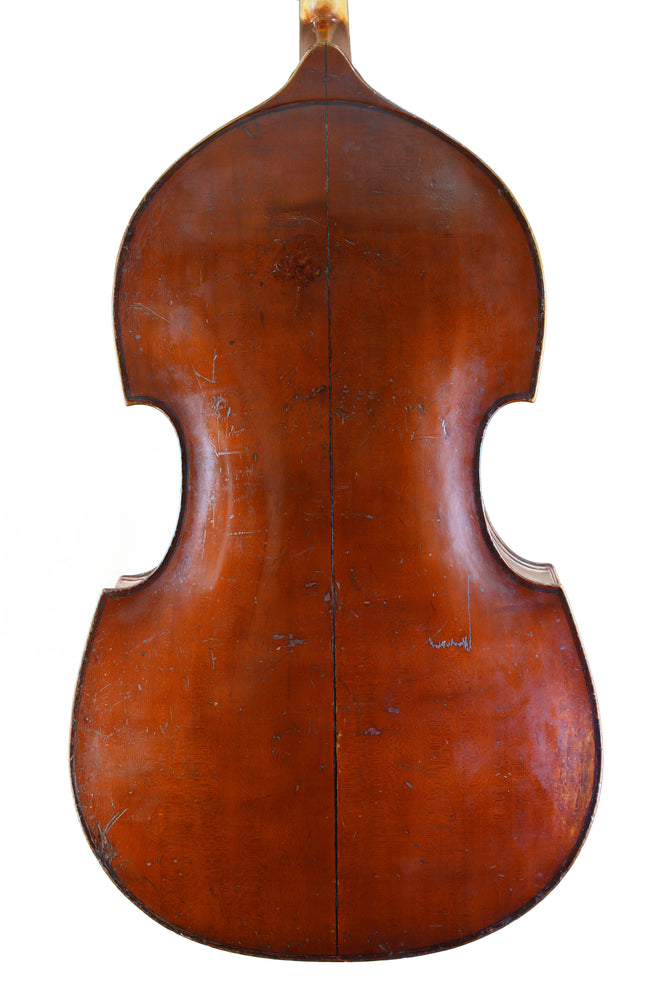
Closer inspection revealed that the work done on the instrument wasn't at all sympathetic.
Well you name it and it had been done badly. All the cracks and seams had been glued up with a modern acrylic type glue that had set like crystal glass and the new neck had all the wrong measurements and a most impractical low angle.
A huge amount of time was spent just trying to remove the acrylic glue from
the cracks and seams. The actual repair invoice from our outworker itemized
the programme of work as follows: "Remove back, remove back braces, repair
back centre-joint, make and fit new back braces, make and graft in new
back button, replace back. Remove front, half-edge and edge as necessary,
fit new bass bar, repair cracks in front, repair cracks in ribs, build
up C-ribs and reconstruct top block. Cheek head and fit new machines. Make
and fit new neck with fingerboard and graft scroll. Clean and touch in
varnish. Fit bridge, endpin and soundpost etc.
Yes - the total bill was a little under £8500-00 GBP. The figure includes
the cost of a new neck block, all fittings and UK sales tax.
Thank you. We are confident that the instrument is back to its former glory and ready to be enjoyed.
We think that you'll be most impressed. Power and tonal qualities are really excellent. The whole instrument vibrates well when bowed - so just imagine a quality of sound that has the ability to make the hair on your arms tingle and stand almost upright. That's a fabulous feeling.
Every player loves the big velvety sound of the Brock. In the past they have struggled ever so slightly with the upper shoulders.
Yes. In March 2012 we reset the neck in order to bring it out from the body of the instrument by another 10mm. The overstand is now 40mm. Restorer Jeroen Bruynooghe also re-profiled the neck, re-profiled the fingerboard, adjusted the bridge and took some time fitting a new soundpost.
Yes its about five days work in total.
Yes very. The bass is accessible in all positions and plays like a dream.
We have calculated that in the seven year period April 2005 - April 2012 the "Hegner" appreciated
in value by 9.4% year on year.
When you consider that during this same period most traditional forms of investment
have struggled to perform with any sort of return at all - the return on
the "Hegner" has been nothing short of phenomenal.
Yes there is a repair label on the inside back, bass side - just above the
central brace. It reads "Repareret af Jorgen Nielsen, VIOLINBYGGER, København 1918". We also inserted a replacement label on the lower side of the back central brace stating "Made
by Alfred Nilsson Brock, Stockholm, Sweden anno 1903."
Yes indeed. A thousand thanks to the following;
1) Luin Sitkey for his invaluable help in identifying the instrument, for
his help in tracing its more recent history and for gifting The Contrabass
Shoppe Ltd his only copy of the book "Kungliga Operans kontrabasar och bassister" by Börje
Ljungkvist.
2) Michael Karlsson for his invaluable support and interest in the history of the instrument. Also for his generous assistance in translating Swedish text into English.
3) Börje Ljungkvist for his dedicated research into the double basses
and bassists of the Royal Opera. Also for the recommendation that I contact
Hans-Martin Riben at the Stolkholm Music and Theatre Museum.
4) Hans-Martin Riben for his prompt and efficient response to my enquiries, for granting me permission to use his images of original documents currently housed at The Music and Theatre Library of Sweden and for granting me permission to use a translation of text from private correspondence.
5) Magnus Nygårds for his feedback regarding the Royal College of Music.
6) Roland Nilsson the current (April 2012) owner and managing director of N. Nilsson Fiolbyggare AB - for providing the invaluable information on his family's history and for granting me permission to use various text and the images of his great uncle - Alfred Nilsson Brock.
7) Göran Grahn - curator of the Stiftelsen Musikkulturens Främjande
(Music Promotion Foundation of Culture) for his kind assistance.
The "Hegner" is a unique and highly desirable top quality instrument. It was made in 1903 by Royal Court instrument maker Alfred Nilsson Brock for Johannes W. A. Hegner the principal bass player of the Orchestra of the Swedish Royal Opera from 1876 - 1907. In form the instrument is modelled on the Giovanni Paolo Maggini still (April 2012) in the ownership of the Royal Opera. Not only does the "Hegner" have rarity, good looks, advantageous playing stats and a sound quality to die for - it is accompanied by an exceptional amount of documentation and provenance. In the past 109 years (April 2012) of the instrument's existence it has been owned and used by no less than three eminent principal players of the Royal Opera, Sweden. If you are a player, an orchestra, a collector or an investor the "Hegner" is
an instrument that is sure to make you salivate. Some of you may even start
to slobber!
LOB (length of back) - 110.0cm (43.26in)
Width across upper bouts - 50.7cm (19.96in)
Width across middle bouts - 35.0cm (13.75in)
Width across lower bouts - 67.0cm (26.40in)
Depth of lower ribs inc both plates - 22.0cm (8.65in)
Body stop - 59.7cm (23.50in)
String length - 105.2cm (41.46in)
Review compiled by: Anthony Houska - MD The Contrabass Shoppe Ltd.
Review completion date: 16th June 2012.
|