
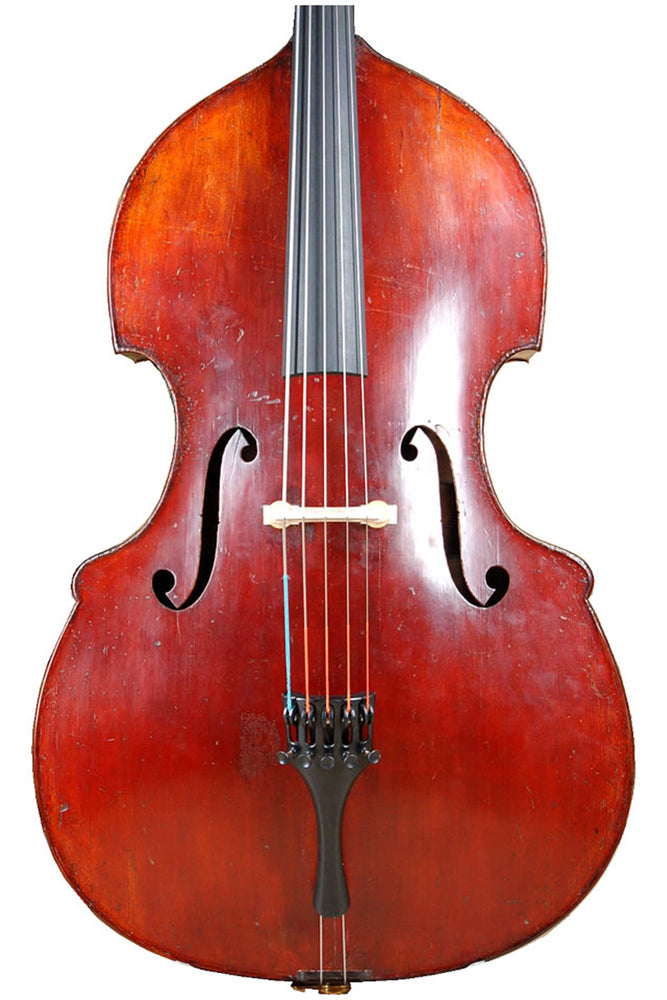
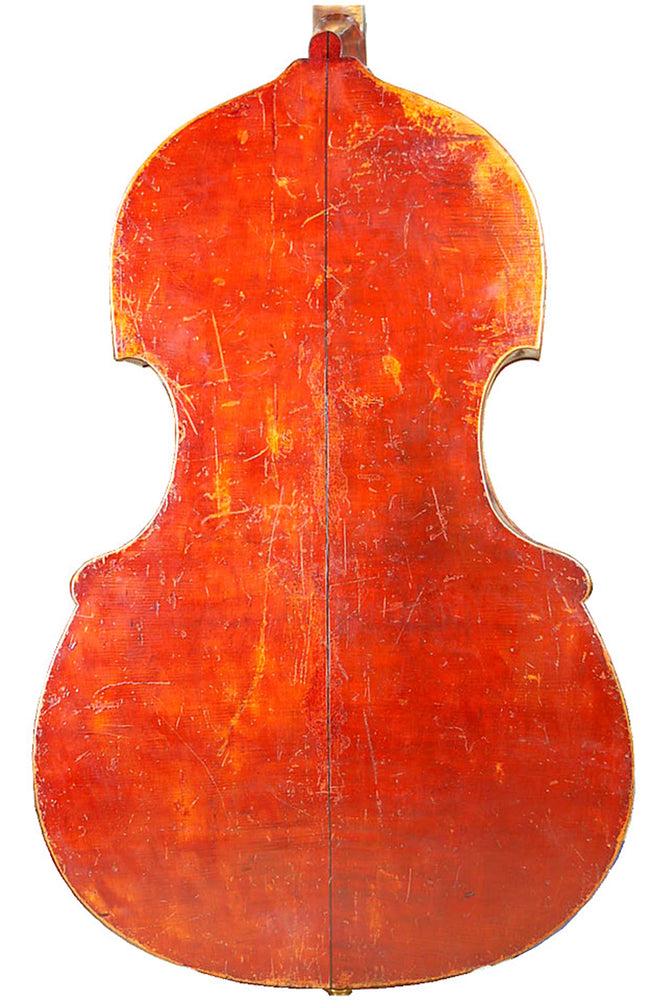
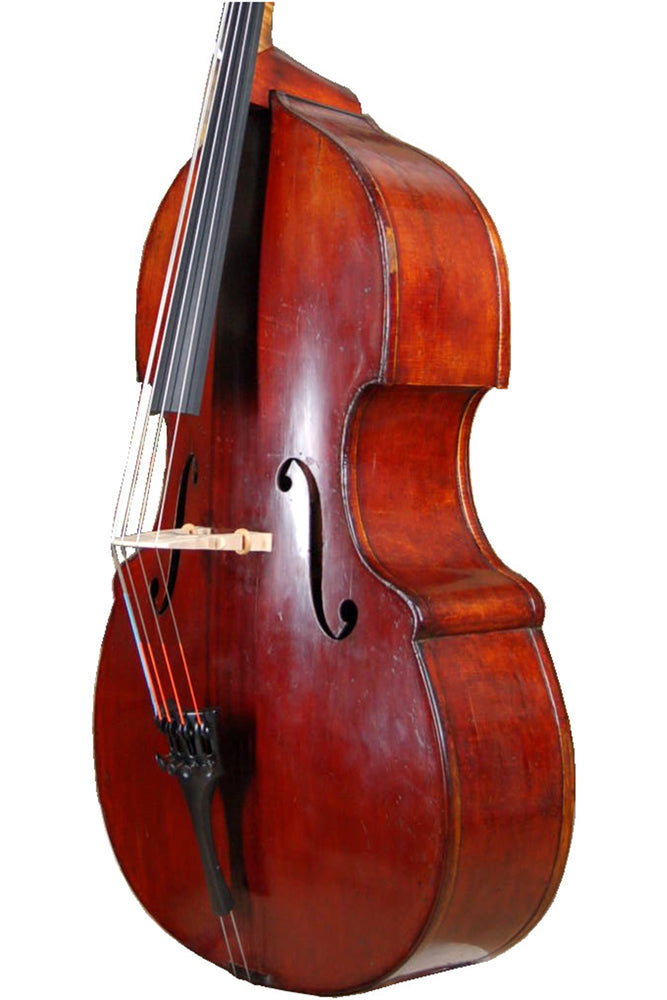
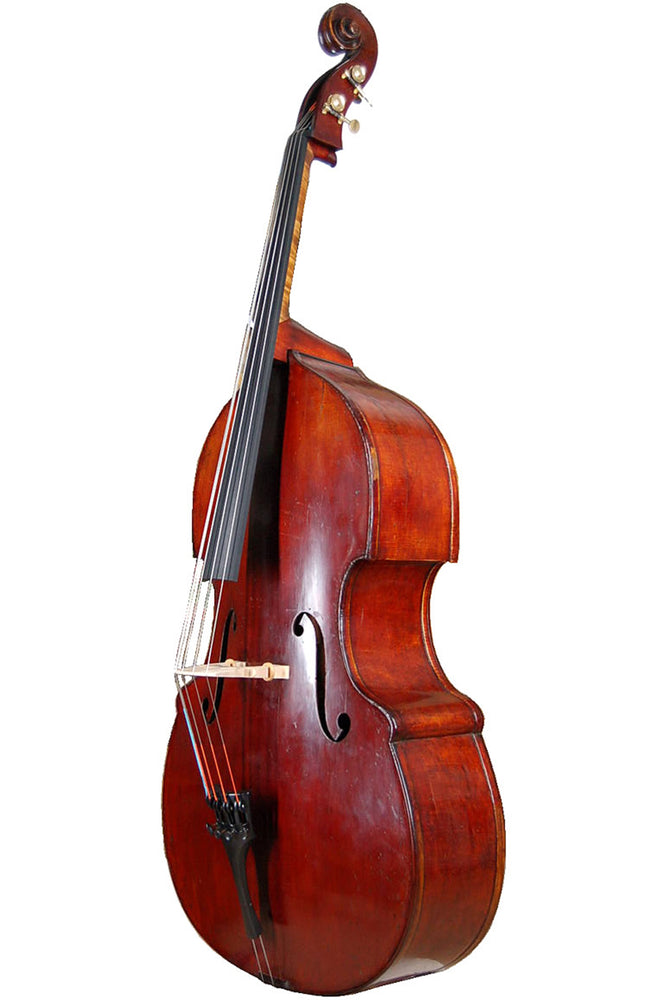
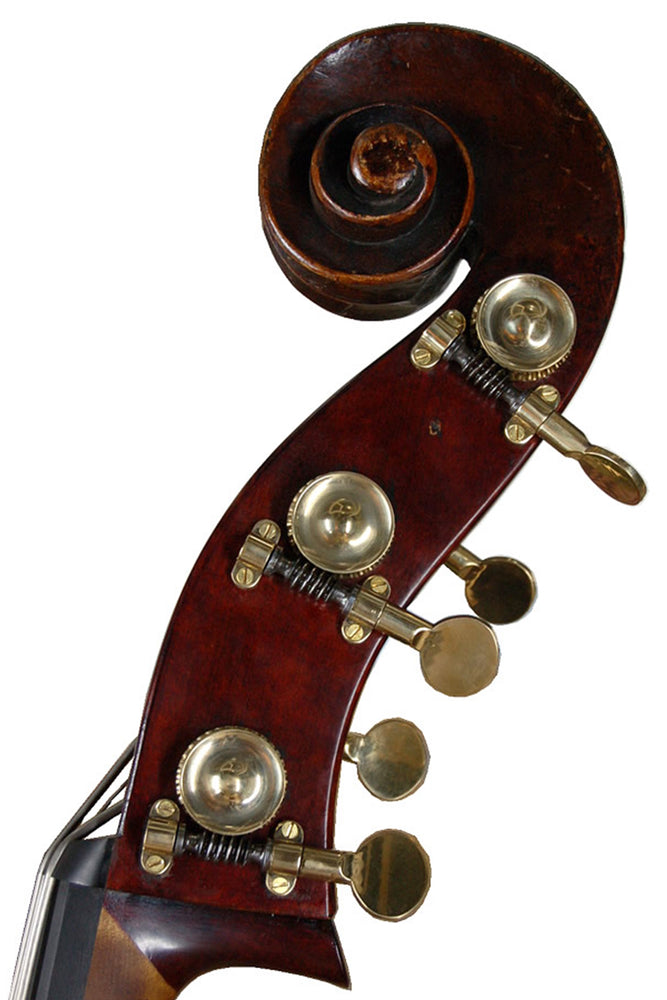
Large 5 string Double Bass by Ferdinand Seitz, circa 1850 - #2721
Big bass.
Yes - this is one of those magnificent instruments
with the rounded or "Busetto" type lower corners in the style of Mathias
Klotz (1653-1743) that are quite awesome in every aspect. With
a length of back (LOB) measurement of 118.3cm - this really is
a true 5/4-size instrument.
Is the string length big as well?
No. Even though this is about as big an instrument
as one will find - it is still very playable due to the fact that
The Contrabass Shoppe has fitted a stunning "slim-feel" neck that
provides a string length of only 105.4 cm. Can you believe that
statistic? Only 105.4cm. So big bass - but incredibly easy to
play.
Big Sound?
Yes indeed. As one draws the bow across the strings
the whole instrument begins to vibrate and a simply colossal sound
really makes its presence felt. I promise you - you won't be able
to stop smiling at the enormity of sound. Hold on to the china
plates!
Is the bass labelled?
No unfortunately it doesn't have a label or inscription.
How do you know that it is made by Seitz?
The instrument is typical of Seitz`s output. You
could say - that these magnificent instruments were his trade mark.
If you take a look in our Archive pages - you will see another
example of Seitz`s work. The near-identical example is signed in
ink - 'Ferdinand Seitz 1856' on the bass side lower table.
How do the two instruments compare?
In terms of model, workmanship and quality of timber
used - the two instruments are very, very similar. In terms of
overall condition - we would have say that this one is the more
superior on the basis that it still retains its glorious plumb
red-brown spirit varnish.
Ferdinand Seitz - he was famed for his
basses wasn't he?
Yes he was. Although there is very little recorded
about Ferdinand Seitz - even in the larger reference books - double
bass players the world over recognise his name as being synonymous
with these large well sounding orchestral instruments. German players
especially favour these 5/4 size instruments that were often made
- as is this example - with the rounded or "Busetto" type lower
corners.
More on Seitz
Ferdinand worked around about 1840-1857. There were
several generations of violinmakers with the name Seitz. Most of
them worked in and around Mittenwald. The Encyclopaedia on Violin
Makers by Karel Jalovec records no less than 18 with a surname
spelt either Seitz or Seiz. Many of the makers worked for or supplied
instruments or parts of violins exclusively for the dealers and
manufacturers of the time - namely Matthias Neuner (3rd) and Matthias
Hornsteinster.
More on Mittenwald
Mittenwald is located at the foot of the Bavarian
Alps in the very south of Germany. Between the end of the 15th
and the 17th century Mittenwald prospered as it lay directly on
the lower trade route between Augsberg and Venice.
More on Mathias Klotz
Mathias Klotz (1653-1743) can be considered the
founder of violin making in Mittenwald. In 1685 he returned to
the town and opened a large workshop in which he trained his three
sons as well as many other violin makers from the area. Today the
town still has a violin making school and there is a museum devoted
to the evolution of stringed instruments and to old Mittenwald.
Instrument characteristics
This instrument is made in the traditional style
of the Mittenwald School. It is viol shaped with rounded or "Busetto" type
lower corners. It has a flat back that slopes gently in towards
the neck and along the length of the back centre join is a characteristic
strip of ebony. The wood used is nicely figured, well thicknessed
and of good quality. The carving details of the scroll, ƒ holes
and purfilling are neat and well controlled. The varnish is original
and very typical. Just take a look at the glorious texture and
deep-dark red-brown colour. Splendid stuff indeed.
Have you done anything to the instrument at all?
Yes - the instrument has been fully upgraded to
modern day concert standards. In brief we`ve set the instrument
up with a new neck, fingerboard, bridge and post and the peg box
is now adorned with a stunning set of new English machines set
on brass half plates. Internally improvements have been made to
the acoustics by means of judicious regraduation work and the replacement
of the original bass bar.
Phew - all in all that was quite a bit
of work then?
Yes indeed it was. But in our opinion it has been
worth all the effort - for the instrument is now structurally in
A1 condition.
Tell
me about the sound again?
The quality of sound is simply awesome.
There is huge 'octobass' like sound which can only be described
as glorious and reverent. There is plenty of volume and the tone
is rather like a fine red wine - mature and full-bodied.
Tell you what. Why don't you have a little listen to this sound clip of Burkhart Mager playing the Seitz? Burkhart is joint solo bass with the Orchestra of the State Opera House, Stuttgart.
Would I want this instrument?
Named instruments by Ferdinand Seitz are considered
highly desirable property right around the world. With volume and
tonal qualities at the very highest level - this instrument will
help establish and elevate the foundational or core-sound of any
opera orchestra.
Stats:
LOB (length of back) - 118.3cm (46.51in)
Width across upper bouts - 55.2cm (27.75in)
Width across middle bouts - 39.5cm (15.60in)
Width across lower bouts - 76.2cm (20.0in)
Depth of lower ribs inc both plates- 22.2cm (8.75in)
Body Stop - 60.60cm (23.85in)
String length - 105.4cm (41.50in).