
|
Yes - there really aren't that many good five string
instrument about simply because there aren't that many instruments
available that have the correct proportions and structural integrity
to be able to handle the fifth string and those lower notes. It's
just no good whacking a five string neck on a standard sized 4/4
size instrument and expect it to produce the goods.
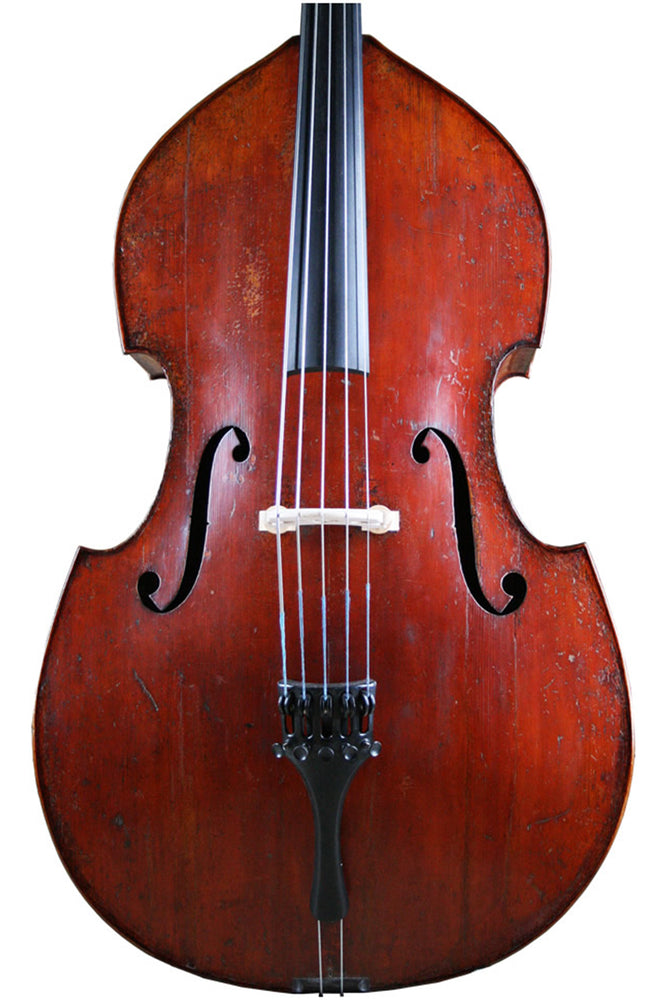
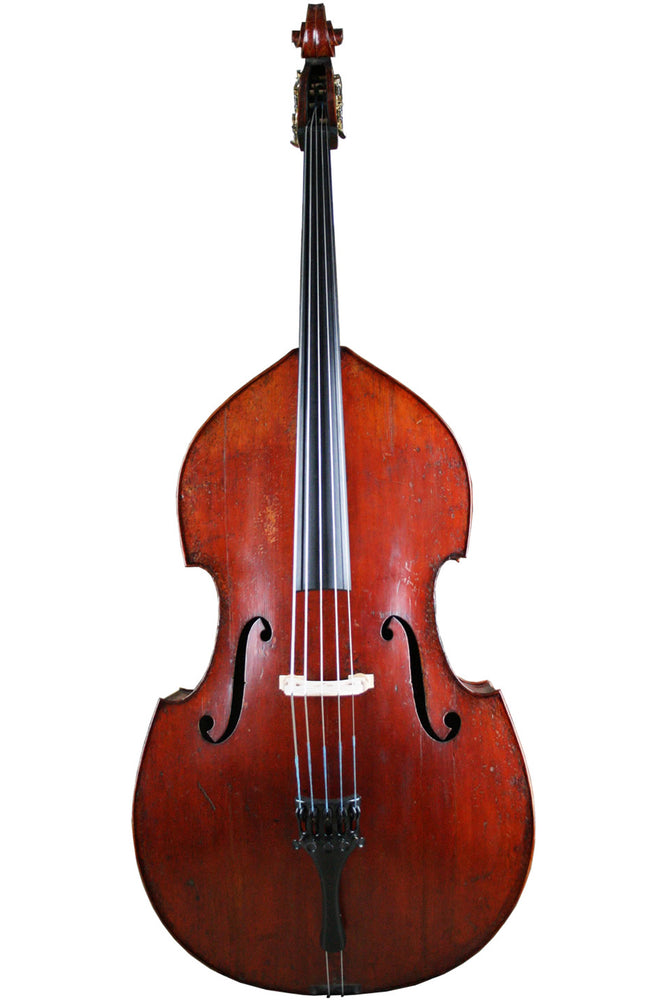
How about this magnificent instrument by Neuner & Hornsteiner
that is labelled and dated 1880. It is what we call a true 5/4
size instrument and it is blessed with the type of proportions
and the sort of condition that are absolutely perfect for producing,
amplifying and projecting those deep dark rounded sounds that are
the prerequisite of a top quality five string instrument.
As one draws the bow across the strings the whole
instrument begins to vibrate and a simply colossal sound really
makes its presence felt. I promise you - you won't be able to stop
smiling at the enormity of sound. Hold on to the china plates!
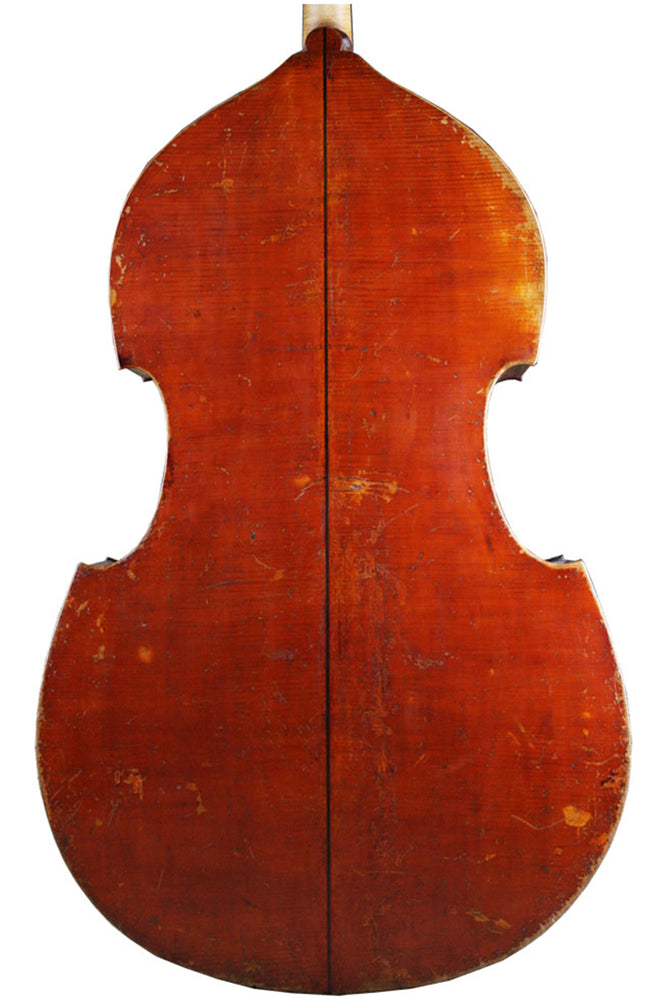
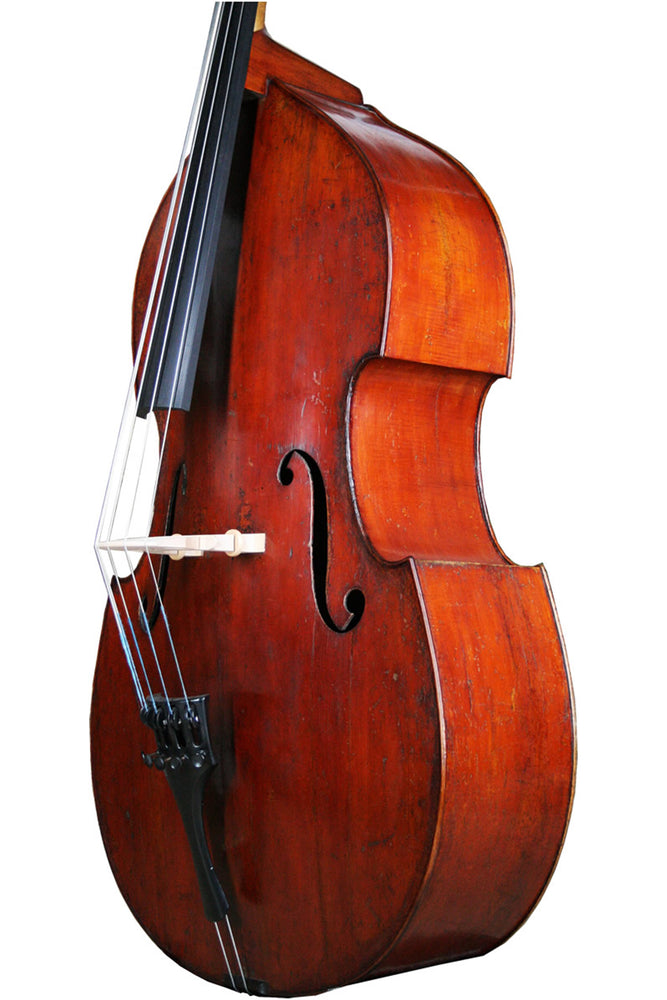
This instrument is made in the traditional style
of the Mittenwald School. It is viol shaped with a flat back that
slopes gently in towards the neck. Along the length of the back
centre join is a characteristic strip of ebony. The wood used is
nicely figured, well thicknessed and of good quality. The carving
details of the scroll, ƒ holes and purfilling are typically neat and
well controlled. The varnish is original and also very typical.
Just take a look at the glorious texture and deep-dark red-brown
colour over a yellow ground. Splendid stuff indeed.
No. Even though this instrument is amongst the largest
that one will find - it is still very playable due to the fact
that The Contrabass Shoppe has fitted a stunning "slim-feel" neck
that provides a string length of only 106.8 cm. Can you believe
that statistic? Only 106.8cm. So big bass - but incredibly easy
to play.
Yes the instrument bears its original printed label
on the inside central-back brace. The label reads "Neuner & Hornsteiner
Mittenwald (Baiern) 1880" followed by the N/H within a circle
monogram.
Mittenwald is located at the foot of the Bavarian
Alps in the very south of Germany. Between the end of the 15th
and the 17th century Mittenwald prospered as it lay directly on
the lower trade route between Augsberg and Venice. In 1685 Mathias
Klotz (1653-1743) - considered to be the founder of violin making
in Mittenwald - returned to the town and opened a large workshop
in which he trained his three sons as well as many other violin
makers from the area. Today the town still has a violin making
school and there is a museum devoted to the evolution of stringed
instruments and to old Mittenwald.
I have been reliably informed that an 1880 population
census established a figure of some 4000 residents in the town
of Mittenwald out of which there were some 200 violin makers. That's
quite an astounding number - in fact approximately 10% of the working
population.
Yes. The Encyclopaedia of Violin-makers by Karl
Jalovec (pub. Paul Hamlyn 1968) summarises the history of the firm
as follows: "A
factory for the production of bowed instruments, founded 1750.
Up to 1812 it was called Gebrüder (Brothers) Neuner, then
Matthias Neuner, under Matthias Neuner (1V); finally Neuner & Hornsteiner.
At the end of the 19th century it was owned by the dealer Altenöder
and Ludwig Neuner (II)." The factory had its own sawmill
and stocks of wood, employed as many as 180 workers and produced
in the region of 15 000 instruments a year. From 1920 the firm
was owned by Hans Neuner.
Yes - that is correct. In fact the number of surnames recorded
under both names is quite staggering. There are 18 makers with
the surname Neuner recorded in the Jalovec Encyclopaedia - 14 of
whom were either born or worked in Mittenwald. The same Encyclopaedia
records no less than 31 with the surname Hornsteiner - 28 of whom
were either born or worked in Mittenwald. An additional two out
of the total number of Hornsteiners are recorded as having attended
the violin making school.
Unfortunately comparative information provided by
the main reference books - is quite vague and conflicting - however
according to the Encyclopaedia on German & Austrian Violin Makers by Karl Jalovec
(pub. Paul Hamlyn 1967) Matthias (111) Neuner worked from 1795
- 1830 and was the founding member of the partnership. The paragraph
reads as follows; "Though a skilful violin maker he was a
still better business man. He enlarged the inherited workshop and
through journeys abroad he greatly increased the importance of
the firm Neuner & Hornsteiner. Violins bearing his name were
made by him in his earlier years. Later he employed minor violin
makers in Mittenwald and started factory production. The later
violins lack real distinction, whereas the earlier ones have individual
character."
Directly opposite the listing in the German & Austrian Violin
Makers Encyclopaedia is a facsimile of a label that reads "M;
Neuner & Hornsteiner aus Mittenwald an der Isar". In addition
The Contrabass Shoppe sold - some years ago - a quality German
double bass by Ferdinand Seitz that bore a faint pencil signature "Ferdinand
Seitz 1837" on the lower inside table and a "M. Neuner
and Hornsteiner, aus Mittenwald an der Isar" label on the
centre brace.
It establishes two things. Firstly that Neuner and
Hornsteiner amalgamated in or prior to 1837 and secondly that Ferdinand
Seitz - a maker synonymous with producing large well sounding orchestral
instruments - was supplying instruments to the N & H firm.
There were several generations of violin makers
with the Seitz name, most of who worked in Mittenwald. Ferdinand
worked around about 1840-1857. The Encyclopaedia by Karel Jalovec
records no less than 18 with a surname spelt either Seitz or Seiz
many of whom worked for or supplied instruments or parts of violins
exclusively for the dealers and manufacturers such as Neuner and
Hornsteinster.
Unfortunately none of the major reference works
that we have available in our library provides a definitive answer
or even suggests an area for further research regarding this important
question. Indeed the lack of clear information is suggested in
the beautifully produced volume Alte Geigen und Bogen - published
in conjunction with the convention of the International Society
of Violin and Bow Makers that was held in Köln in 1997 (ISBN 3-00-001441-1) when it
states that the genealogy of the Hornsteiner family has hardly
been researched.
The following were consulted;
1) Karl Jalovec - 2 volume Encyclopaedia (pub. Paul
Hamlyn 1968).
2) Karl Jalovec - German & Austrian Violin Makers (pub.
Paul Hamlyn 1967).
3) Fridolin Hamma - German Violin Makers (pub William Reeves Bookseller
Ltd 1961).
4) Walter Hamma - 2 volume Violin Makers of the German School (pub
Hans Schneider 1986).
5) Alberto Bachmann - An Encyclopaedia of the Violin (pub The Library
Press Ltd 1925).
6) William Henley - Universal Dictionary of Violin & Bow
Makers (Amati Publishing Ltd 1973).
Yes - a combination of natural catastrophes, war,
economic recession and perhaps most importantly - the secularization
of Southern Germany and the Hapsburg lands resulted in the sales
of violins being taken over by a number of retail organisations.
By the early 19th century retailers such as Neuner, Hornsteiner,
Baader, Jais, Kriner and Woernle were fully in control over violin
making in Mittenwald. What would be made and how - was dictated
and the purchase and sale prices established and controlled.
Violin makers became dependant on the retailers
and as the demand for inexpensive, simply made instruments began
to increase - the general quality and individuality of the instruments
produced began to decline. Violin making became a "piecework trade" in
which individuals specialized in doing one step of the process.
By the middle of the 19th century the division of labour was
so extreme (there were specialists in making instrument bodies,
in carving the neck and scroll, in varnishing the instruments
etc) that there were very few makers in Mittenwald that could
still make an instrument from start to finish.
In 1853 The Mittenwald Violin Making School was
founded with the support of Maximilian 11, the King of Bavaria.
The objective was to help makers learn more about their craft and
to offer support and advice to the workshop owners and their employees.
Yes - Ludwig Neuner (1840-1897) from the company
Neuner & Hornsteiner
deserves special mention. Ludwig learned violin making in Munich,
Berlin and then in Paris - where he worked with J.B Vuillaume for
seven years. While with J.B. Vuillaume Ludwig was able to study
many fine examples of classic Italian violins and indeed Vuillaume's
own work and models. On returning to Mittenwald - Ludwig engaged
the best of the Mittenwald craftsmen to copy the instruments -
working with them to encourage a rise in the general level of quality
produced in Mittenwald.
Yes - The Universal Dictionary of Violin & Bow Makers records
that he took over the control of the company and suggests that
this was in the year 1883 - following the death of his father and
brother. The Jalovec Encyclopaedia records that Matthias (V) Neuner
(1831-1890) was also a partner in the firm and adds that at one
time he was the mayor of Mittenwald.
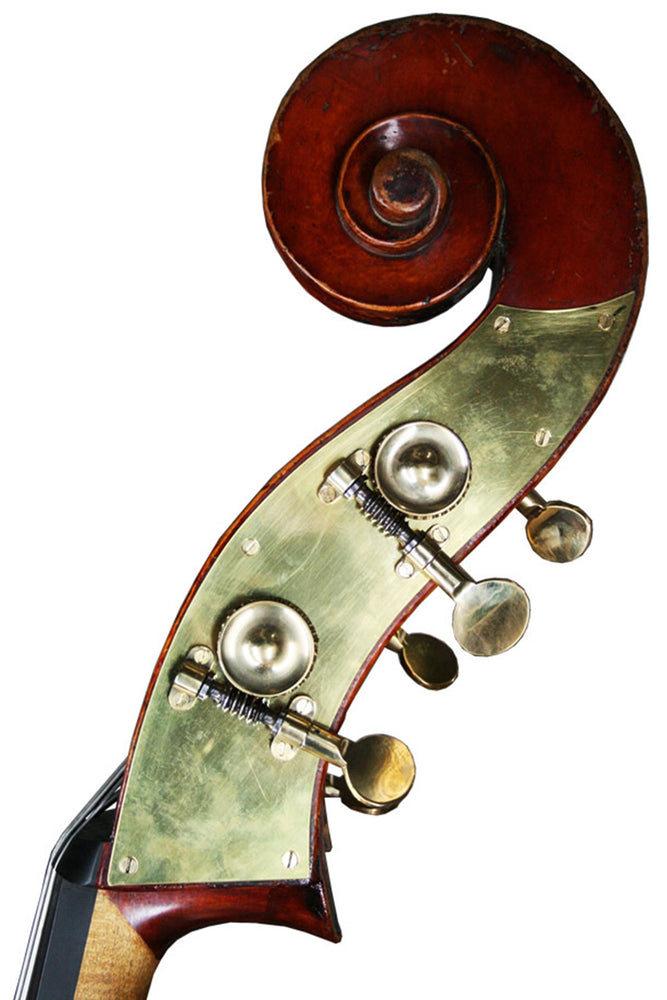
Yes - the instrument has been fully upgraded to
modern day concert standards. In brief - we've reduced the body
length slightly in order to provide a manageable string length.
We've then fitted it up with a new neck, fingerboard, bridge and
post and the peg box is now adorned with a stunning set of new
English machines set on brass half plates. Internally - improvements
have been made to the acoustics by means of judicious regraduation
work and the replacement of the original bass bar.
A support patch to the vulnerable post area has
been fitted and half-edging and edging work has been performed.
Yes indeed it was. But in our opinion it has been
worth all the effort - for the instrument is now structurally in
A1 condition.
The quality of sound is simply awesome. There is
huge 'octobass'
like sound which can only be described as glorious and reverent.
There is plenty of volume and the tone is rather like a fine red
wine - mature and full-bodied.
This instrument was made for the Neuner & Hornsteiner Company
in 1880. Although we do not know the actual makers name it is very
near in quality to the work of Ferdinand Seitz - the renowned Mittenwald
bass maker - who we know produced instruments for the N&H Company.
With volume and tonal qualities at the very highest level - this
instrument will help establish and elevate the foundational or
core-sound of any orchestral or opera orchestra.
A truly magnificent five string instrument in exceptional
condition.
LOB (length of back) - 117.4cm (46.20in)
Width across upper bouts - 54.7cm (21.50in)
Width across middle bouts - 40.7cm (16.0in)
Width across lower bouts - 73.0cm (28.75in)
Depth of lower ribs inc both plates- 22.6cm (8.85in)
Body Stop - 61.3cm (24.15in)
String length - 106.8cm (42.0in)
|