
|
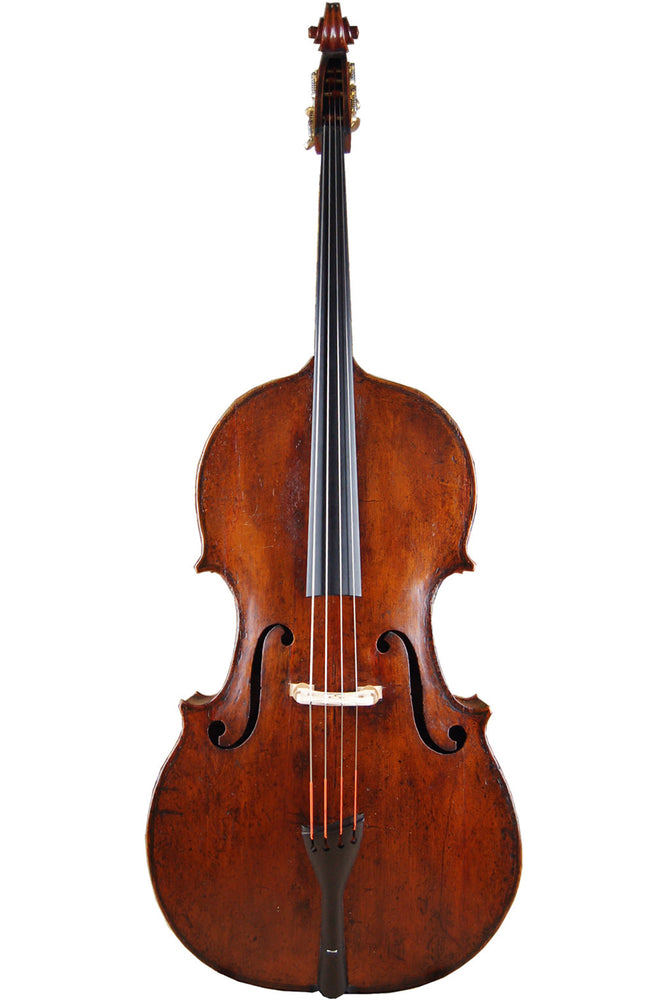
This is an absolutely magnificent example of
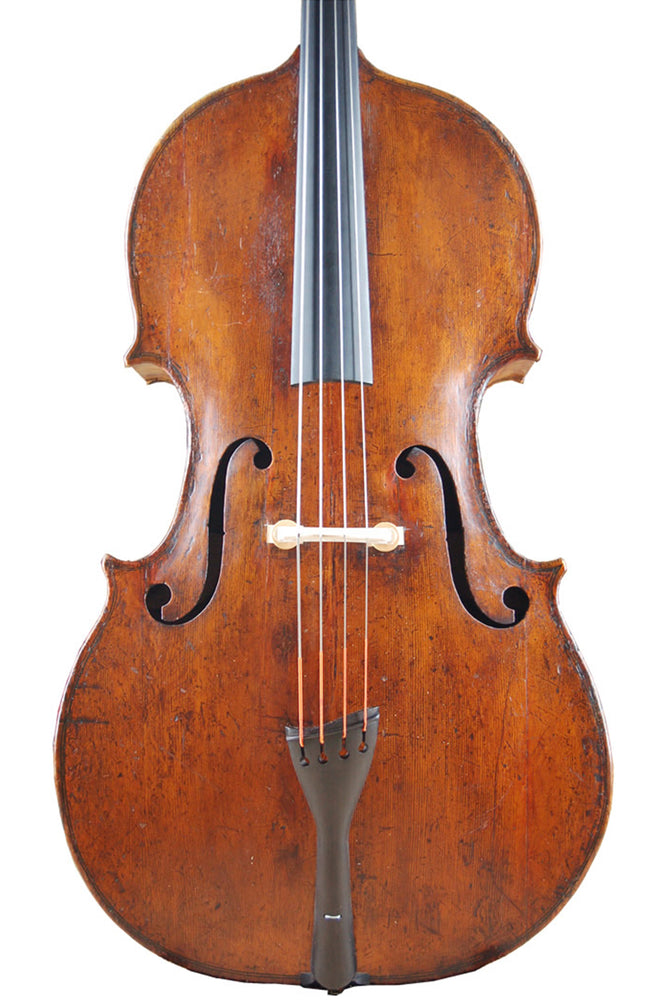
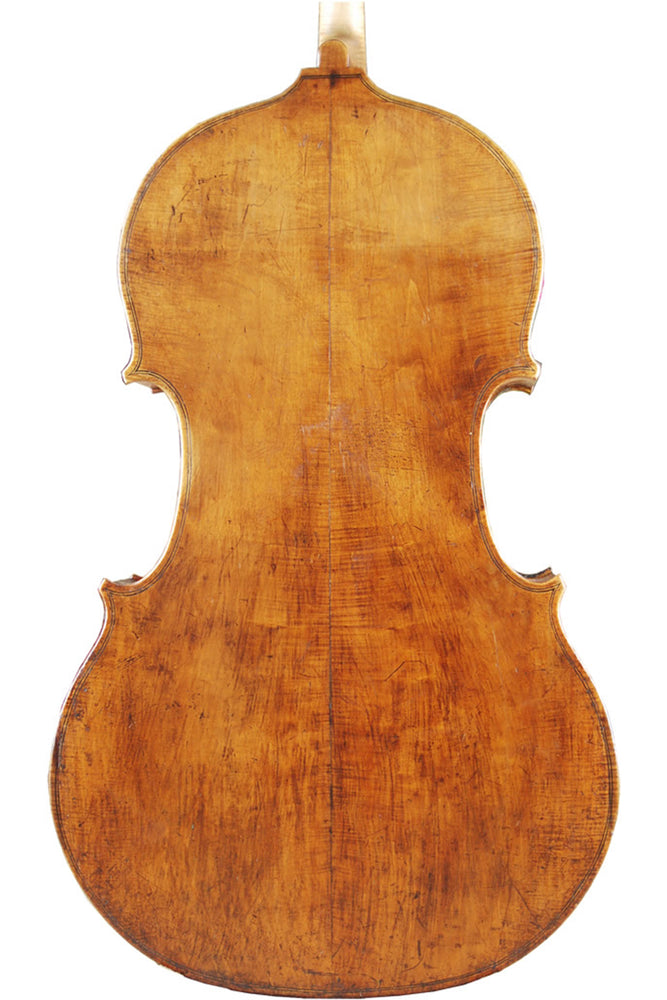
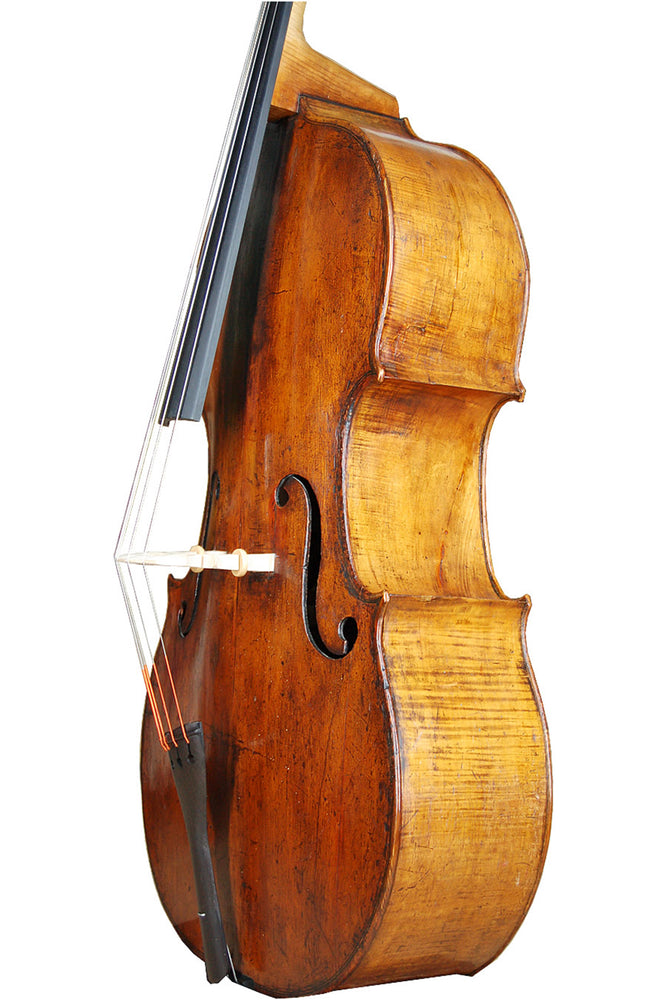
the work of George Craske. It is of violin outline and has a
flat back with upper angle break. The front and back have an "affect" purfilling.
The golden-brown varnish is the original. The instrument bears
two repair labels on the inside back and a pen inscription on the
bass side lower- rib. Unfortunately there is no maker's label or
inscription present.
If you have interest or have studied the violin
family of instruments you will undoubtedly have come across the
luthier George Craske for he was one of the most prolific of all
makers.
Well if you had - the first thing that would spring
to mind as soon as you cast your eyes over this well-proportioned
instrument would be "If this was a violin it would be a Craske".
Yes. Although Craske is acknowledged as a cleaver
copyist - an imitator of the great masters - the style of work
is easily recognizable.
He made copies of Amati, Stradivarius, Maggini and
Guarneri and occasionally a model of his own design. In particular
however - he favoured the work of Giuseppe Guarneri (1698 - 1744)
also know as Guarneri del Gesù.
It had become a much more popular choice for the
player over the Stainer-Amati type models due to the astonishing
impact that Paganini had on the English and indeed Western European
musical scene.
As a direct consequence of his first tour of Great Britain in June
1831 during which he gave some 140 concerts over ten months and
absolutely astounded audiences - the demand for copies of his 1742 "Il
Cannone" simply soared.
Well for starters - the F-holes just seem to hit
you in their form, positioning and execution. They are absolutely
classic examples of Craske's Guarneri copies. Next I'd have to remark
on the edging and arching of the table which is quite flat and
also very typical of his output. Also typical is the selection
of wood and his use of stain to bring out the grain on the table
of the instrument.
No problem. Remember that I mentioned that Craske
was a prolific maker - well the monumental reference work - the "Universal
Dictionary Of Violin & Bow Makers" by William Henley
(Amati Publishing Ltd - 1973 3rd Edition) notes that Craske's
output amounted to 2050 violins, 300 violas, 250 cellos and 20
double-basses. What this tremendous productivity means is that
whenever the major UK auction houses - namely Sotheby's Christie's
and Bonhams - stage their thrice yearly musical instrument auctions
- Craske's work appears regularly.
Yes exactly. In any random selection of catalogues
from our library an impressive number of instruments are virtually
guaranteed. For example - in the Sotheby's November 1994 catalogue
no less than three instruments appear with pictures out of total
of one hundred and fifteen violins, violas and cellos. That's 2.61%
of total violins, violas and cellos!
No. Out of the catalogues consulted not all the
instruments were pictured and of the examples that were - most
were in black & white
and of either the back or front view only. Those instruments
that were pictured in full colour were by far the superior in
quality and condition.
No - not to our knowledge. A productivity of only
20 instruments - of which a proportion - we can assume - are no
longer in existence - translates to the fact that the double basses
are pretty rare things to come across indeed. In fact the last
instrument that we ourselves saw by Craske was over 20 years ago.
Yes sure - with catalogues divided into violins,
violas and cellos.
Violins:
Bonhams & Brooks 18/09/01 lot 179 dated 1859
(Full colour front, back and scroll views)
Christie's 17/03/99 lot 131 with Hill number 9904 on fingerboard
end (B&W front view only)
Bonhams 31/03/98 lot 143 labelled "special quality" (B&W
front & back views)
Sotheby's 14/06/90 lot 104 dated 1856 (B&W back view only)
Sotheby's 23/11/89 lot 234 with Warren certificate (B&W back
view only)
Sotheby's 23/11/89 lot 390 (B&W back view only)
Sotheby's 04/11/82 lot 562 (B&W back view only)
Sotheby's 04/11/82 lot 732 labelled "special quality" (B&W
back view only)
Christie's New York 02/12/94 lot 124 dated 1845 (B&W back
view only)
Violas:
Sotheby's 23/11/89 lot 367 (B&W back view only)
Sotheby's 04/11/82 lot 658 labelled "special quality" (B&W
back view only)
Cellos:
Bonhams 05/11/07 lot 166 dated 1849 with Voight
certificate (full colour front & back views Bonhams 19/03/97 lot 63 dated 1845
with double purfilling (B&W front & back views)
Phillips 19/11/96 lot 251 with Hill number 1344 on fingerboard
end (B&W front & back views)
Yes. This double bass looks every bit like a big
Craske violin and as mentioned previously - Craske was fairly consistent
in his choice of wood, aching and finish.
Yes there are a couple of really good examples.
The front view of the violin - lot 131 in Christies March 1999
auction well-captures the Guarneri type F's, the flat edge and
arching, the fairly pointed corners and the strong straight grain
lines. The front view of the 1845 cello - lot 63 in Bonhams 1997
auction catalogue - additionally captures the placement, cut and
angle of the F's on a much larger instrument particularly well.
On the cello it can be observed that the treble side F-hole appears
to be slightly lower, slightly shorter and cut at a slightly greater
angle than the one on the bass side. Looking at our double bass
- it too shows a near identical asymmetrical positioning and cut
of the F's.
Many of Craske's other instrument also display -
either to a greater or lesser degree - a similar variance in the
positioning and cut to the F's - so a plausible explanation must
include the suggestion that Craske was trying to reproduce some
of the genius of Del Gesu's later work (Described as "eccentric
irregularities" by
Arthur, Alfred & William Hill in their 1931 volume "The
Violin Makers of the Guarneri Family") more accurately than
many would give him credit. Alternatively a similar working method
to that of Del Gesu could have developed quite naturally simply
as a result of his experience in making, his speed of work and
his attitude towards the end product.
Well - without getting into a lengthy study of the
work of Del Gesu lets just call it a more expressive, a more colourful,
a more free-hand approach to making in comparison to the mathematically
correct principals of Stradivarius's work.
No that's right - I haven't. Fortunately the Bonham & Brooks
catalogue of September 2001 - lot 179 - shows us in full colour
a front, back and scroll view of a "special-quality" -
as written on the label - violin dated 1859. In this example we
can observe all the characteristics of his work mentioned previously
- with the added bonus of seeing a quality wood selection all shown-off
to good effect by a splendid "antiqued-effect" golden-red-brown
varnish. Other interesting features that can be seen on this example
are a very slightly shaky purfilling and "wings" on the
lower bouts of the table.
Wings are best described as narrow lengths or sections
of wood that are added - most usually - to the lower bouts of a
front or back in order to produce material of sufficient useable
dimensions. On a violin this is rarely seen - because obviously
the width of wood required to make a violin is not that great in
comparison to the making of a cello or double bass front or back.
Looking at the table of our Craske double bass we also see wings
on both the lower and upper bouts - bass and treble sides.
On the double bass it was a fairly common practice
to add "wings".
Regarding the violin it tends to suggest that Craske wasn't prepared
to waste any timber at all. "The British Violin" - published
by the British Violin Making Association in 2000 (ISBN 0 953471
27) mentions that the "enviably old" - well-figured timber
that Craske used throughout his production had been bought from
William Forster - presumably "Young" Forster.
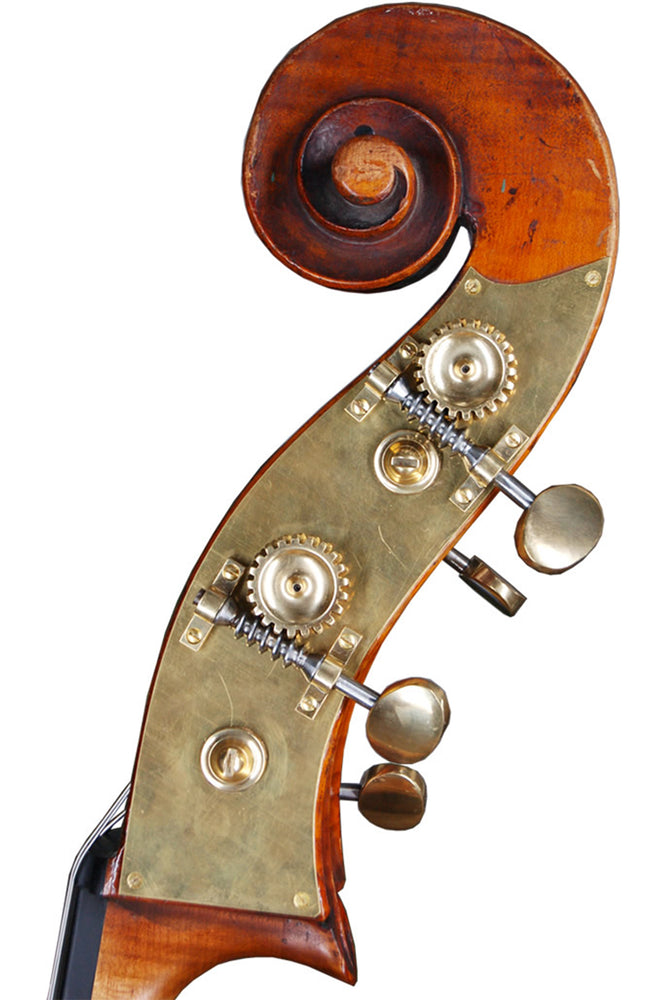
Yes it's quite incredible. The scrolls of both instruments
are virtually identical.
When you make a comparison of the very eye of each
instrument observe the position and shape of the eye and then the
way the volute commences and flows out from it. Observe the general
shape of the scroll, the depth of the cut, the chamfers and the
throat of the peg box. You'll easily conclude that both scrolls
have been cut by the same hand.
Yes - the visible toothing plane marks on the inside
back and ribs and the external scraper marks on the back provide
an insight into some of Craske's speedy working methods. Also the
apparent wide band of purfilling to the front and back isn't a
real purfilling at all but an ebony-dust mixture that has been
filled into two scratched-out channels approximately 3mm apart.
By doing this Craske has created an effect that looks just as good
as the real thing and in the process saved himself the laborious
and time consuming task of making up a purfilling wide enough for
a bass. How ingenious!
In 1901 W.E. Hill & Sons published a lavish marketing pamphlet
or brochure entitled "George Craske - Violin Maker 1795 -
1888" with illustrations beautifully printed from engraving
plates and text printed on a cream antique-wove paper in black
and red ink. The short biographical information contained within
had been written and previously published by George Crompton a
lifelong friend of Craske. Prices for violins were given on page
4 as £20. £25 and £30. Violas and cellos had
already
been sold and were only occasionally available from their customers.
In 1982 the pamphlet was republished by S.A. Kellow with the permission
and assistance of W.E.Hill & Sons.
Yes the Henley Dictionary - already mentioned -
has the next largest (1.25 pgs of small text) entry although much
of the information has obviously been taken directly from the Hill
brochure. In addition one can find a sizeable (1.75 pgs) entry
on Craske in the volume entitled "British Violin-Makers" by Rev
W. Meredith Morris (Published by Chatto & Windus London 1904)
and a third of a page entry in the "Dictionary Of British
Violin And Bow Makers" by Dennis G. Plowright (Published
by Dennis G. Plowright, Exmouth 1994 – ISBN No. 0 9523081
0 X).
Our expectations of a full and authoritative entry
in the beautifully presented "The British Violin" - were disappointing
to say the least. For such an industrious British maker to be
mentioned only in passing in two paragraphs on other makers does
seem rather unjust.
All the main reference dictionaries agree with the
Hill brochure that Craske was born at Bury St Edmunds in 1795 and
died at the age of 93 on the 14th January 1888. In his early years
the dictionaries and brochure record that he was taught by William
Forster. This presumably was "Young" Forster as Craske would only
have been aged thirteen when "Old" Forster died in
1808. At any rate - Craske is recorded as having produced many
instruments for both Forster and Thomas Dodd before departing
to live in Bath. Moves to Leeds and Sheffield followed in quick
succession and then a more stable twenty year period on Snow
Hill in Birmingham. This was followed by Manchester for about
twelve months, Salford for a few months and finally Stockport
- where he lived in seclusion for more than twenty years.
S.K. Fellow states in his foreword to his reprinted
brochure that "When
Hills bought the complete stock in trade of instruments made by
George Craske from his executor, George Crompton they produced
a small brochure on the maker". When you consider the relatively
large difference between Craske's death at the beginning of 1888
and the publishing of the brochure to market them in 1901 - the
acquiring of the instruments directly from the estate doesn't seem
to quite tie in. Indeed Henley takes a different slant on the transaction
and notes that George Crompton was the only person allowed into
Craske's workshop and writes that "Crompton acquired the whole
of Craske's stock". Both Crompton and Henley write that Craske
retired to Bath and lived comfortably on the proceeds. Henley follows
up by writing that Crompton "subsequently did much to popularise
the instruments" but scathingly suggests that he was merely
acting in his own interests for Alfred Ebsworth Hill acquired the "complete
stock". One ex-Hill violin restorer confirmed that it was
from Crompton and not via the Craske estate. Hills then made the
instruments ready for sale and sold them bearing the label "Made
by George Craske, born 1797 died 1888 and sold by W.E.Hill & Sons,
London".
On some instruments Hill craftsmen reworked the
plates and scrolls. On others they replaced the scrolls. The instruments
were then fully set up.
Good question. The two year difference in date from
the accepted date is quite bewildering. At the moment all that
one can suggest is that it was an unfortunate printing error. If
anybody knows the answer to this one we'd love to hear from you.
Yes - the first - a white oblong label - can be
found on the treble side back above the central brace and reads; "Repaired by:
WILLIAM SKELHORN, ALTRINCHAM, CHESHIRE". Between the two printed
Skelhorn and Altrincham lines - the following is written in ink
in small capital letters "NORMAN BEVAN SKELHORN" At the
foot of the label is the date - also written in ink "AUGUST
1960" all apart from the prefix number "19" which
is in print.
Yes - the second label - a faded square orange label
bordered by a decorative link-chain is positioned on the bass side
back - slightly below the central brace. The label is difficult
to read due to damage by dirt, stains, glue-runs and a general
fading of the print and ink but despite this - the following can
be made out; Probably and in very faint ink at the top of the label "Repaired
by" followed in printed capitals "J. HARRAD" with
the line immediately below again in print " -------- ON-
TRENT." At the foot of the label there is some more hand
writing that is extremely difficult to decipher. Most likely
it states the month and day the restoration was completed - for
the line ends with the year 1872.
Yes - the Henley Dictionary provides a short entry
under the name "Harrod".
The misspelling is either an information or typo error but the
maker is definitely the one and the same. The entry reads as follows; "HARROD,
Jack. Amateur. Worked at Burton-on-Trent. Died 1894. Workmanship
has one or two inequalities, nevertheless maintains average merit.
Fifteen violins circulated in his district."
Yes - there is a small inscription in ink on the
bass side lower rib - near to the corner block. It can clearly
be read through the bass side F-hole. "Repaired by Geo Barker 20/7/22 Chesterfield"
Once again the Henley dictionary provides a
short but useful entry as follows; "BARKER, George. Born 1870. Worked at Chesterfield,
1923. Excellent Stradivarian modelling. Oil varnish with amber
basis - transparent red and brown". The entry is followed
by a facsimile of his label.
"Born Hasland, Chesterfield on the 28th November 1870. Lived
and worked in Chesterfield. A printer and musician by trade. He
played piano for the silent films. Moved to Hull between 1902 and
1904 where he played flute in the theatre orchestra. Returned to
Chesterfield after the outbreak of the first world war where he
played in the Chesterfield Symphony Orchestra. Opened a music shop
in Saltergate, Chesterfield which is known to have been in business
in and around 1928. Repairs to stringed instruments and believed
to have made 6 violins and one viola. A very good amateur water
colour painter. He retired to Baslow in Derbyshire. Died February
1953 aged 82."
Quite frankly - not much at all. Despite the outside
of the instrument being in pretty immaculate condition we found
some less than desirable work on the inside.
Well pretty well everything. In fact you could
call it a total rebuild. It would be difficult to itemise everything
but the work included;
i) Fit Patches to the top and bottom block areas.
ii) Replace the top and bottom blocks.
iii) Unglue the front central seam and treble side lower wing.
iv) Realign, reglue and restud the front central seam and treble
side lower wing.
v) Repair and stud bass side wing crack.
vi) Replace three back braces and refit original central brace.
vii) Fit patch to an over-thin (between 2.8 and 3.8mm) area of
upper table.
viii) Regraduate front where necessary.
ix) Fit new bass bar and restore screw holes above bass bar.
x) Remove old velum and stud work from ribs.
xi) Wash out, reglue and stud all old cracks.
xii) Fit half-edging and edging where necessary.
xiii) Fit new back button and replace purfilling where necessary.
xiv) Fit new neck.
xv) Rebush old cog holes in peg box.
xvi) Fit new tuners with brass plates to peg box.
xvii) Clean and touch in varnish.
xviii) Fit fingerboard, bridge, endpin and sound post.
xix) Setup.
Yes - we calculated that the work took up some 320
hours of time over a period of over three and a half months.
Yes of course - for the instrument is now structurally
in A1 condition and sounds exactly how a good English instrument
should.
Full and glorious with a divine touch of clarity
and projection.
Jeroen Bruynooghe - a former Shoppe employee who
has since left to set up a restoration service in France.
Yes - the instrument has a back length
of only 112.6cm. This means that proportionally the whole instrument
is a fair bit smaller than the full-size "Grand" Brescian
models - that can measure upwards of 114.0cm - so traditional of
the English school of making.
The smaller proportions of this instrument will
definitely suit a great number of players. The flat back and nicely
raked shoulders mean that it is very easy to move up into the thumb
position, the higher positions and the areas up in the rosin dust.
The string length of only 105.5cm means that it is not necessary
to stretch and strain ones left hand in the lower positions.
If George Craske had devoted much more of his time
and very capable efforts to the making of double basses he would
undoubtedly rank highly in the annals of bass making greats. As
it is - we are pretty sure that you'll have to wait an inordinate
amount of time before you see another example - let alone one of
this merit, character and condition. If you are a player looking
for a fine concert instrument or a collector with an eye for a
good investment then this well made, superb looking, superb sounding
instrument by Craske ticks all the right boxes for sure.
LOB (length of back) - 112.6cm (44.30in)
Width across upper bouts - 50.9cm (20.00in)
Width across middle bouts - 36.4cm (14.25in)
Width across lower bouts - 66.5cm (26.40in)
Depth of lower ribs inc both plates- 20.0cm (7.85in)
Body Stop - 60.0cm (23.65in)
String length - 105.5cm (41.50in)
|