
|
Yes - the comment has been made quite a few times.
It all has to do with the glorious colours, textures and transparency
of the varnish. This just isn't any old varnish - it is Venetian
varnish.
Yes - throughout the centuries many architects, painters, craftsmen,
composers, and instrument makers were attracted to Venice because
of its cultural vitality, its relative affluence and its political
independence and stability.
Yes - an exchange of information seems to have
been a key factor to the unique style, beauty and homogeny of
the objects created by the artisans. The unique cultural expression
is often referred to as the "Venetian Style".
During the 17th and 18th centuries there were some tough economic
and political times. There was however an enduring demand for entertainment
and both music and art continued to blossom and evolve under the
patronage of nobles and families of high social ranking. In 1637
the first public opera house opened. By the end of the century
no less than 11 theatres had been built.
Yes indeed.
Füssen and Mittenwald were two violin
making centres along the Alpine trade routes through which merchants
had long passed on their way to do business in Germany and Flanders.
Having supplied violins to Venice and aware of the cultural Renaissance
unfolding there - it was - in the main - from these two towns
that many luthiers migrated.
Yes - In 1613 Claudio Monteverdi (1567 - 1643) settled in Venice.
His subsequent appointment to the highly sought after and well
paid post of musical director at the great eleventh-century Cathedral
of Saint Mark was to afford him an advantaged platform - which
was to last 30years - from which to create, advance, refine and
evolve music and instrumentation.
During the late 16th century music had been essentially ecclesiastical
in nature. Choral and organ music was written for both state and
church occasions while instrumental compositions were derived from
vocal models, dances, improvised pieces and variations. Compositions
were often decorated by turns, trills, runs and other embellishments
and included the ricercare, canzonas, dance suites, fantasia, sonatas
and sinfonias that were scored for small groups of melody instruments
accompanied by a basso continuo.
Wind instruments were much softer sounding than today and consisted
of cornets, trombones, flutes, and recorders. String instruments
consisted of the viols, guitars, lutes and a type of long-necked
lute called the theorbo.
The Venetian born Andrea Gabrieli (ca 1520 - 1586) and his nephew
Giovanni Gabrieli (ca 1557 - 1612) expanded the madrigal and motet.
The Venetian organist and composer Claudio Merulo (1533 - 1604)
pushed the toccata to new levels.
Following an excommunication by the Pope in 1605 - Venice acquired
an independence of mind and a secular spirit. From then onwards
- music was performed at secular festivals, the theatre, the opera,
at private concerts and at carnivals and it was scored for much
larger formations of instruments that were capable of producing
stronger, more brilliant, more refined sounds.
One of the leading Venetian opera composers was Monteverdi's pupil
- Pier Francesco Cavalli (1602 - 76). His output of forty-one operas
is a reflection of the steady demand for new works in the city.
Musical construction of the opera was further enhanced by Marc'
Antonio Cesti (1623 - 1669), M.A. Sartorio (ca 1620 - ca 1685),
Giovanni Legrenzi (1626 - 1690) and Antonio Lotti (ca 1667 - 1740).
By the middle of the seventeenth century Italian opera had assumed
the main outlines of form.
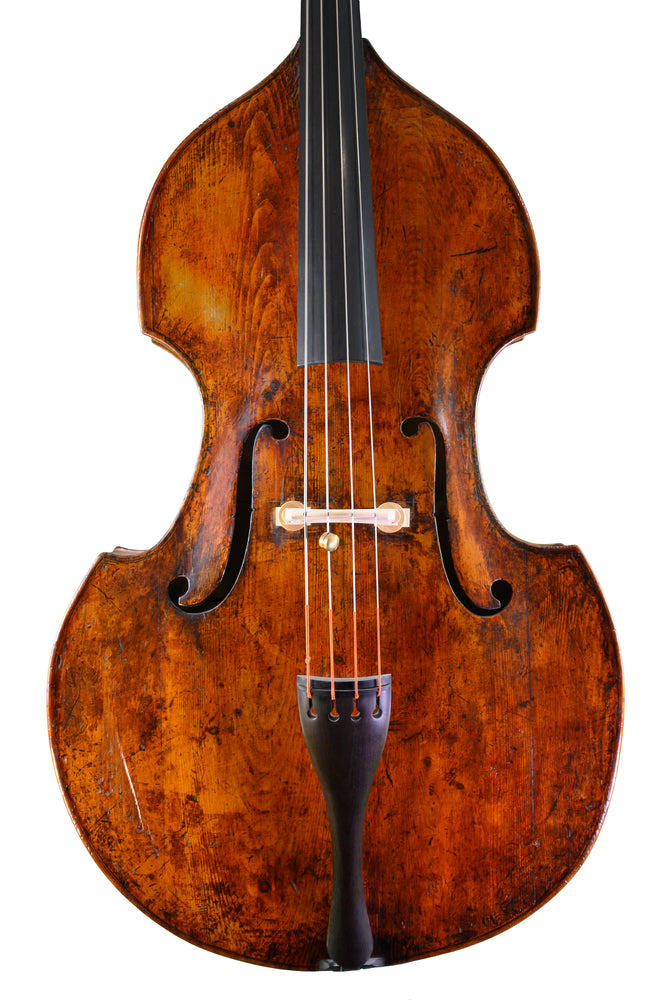
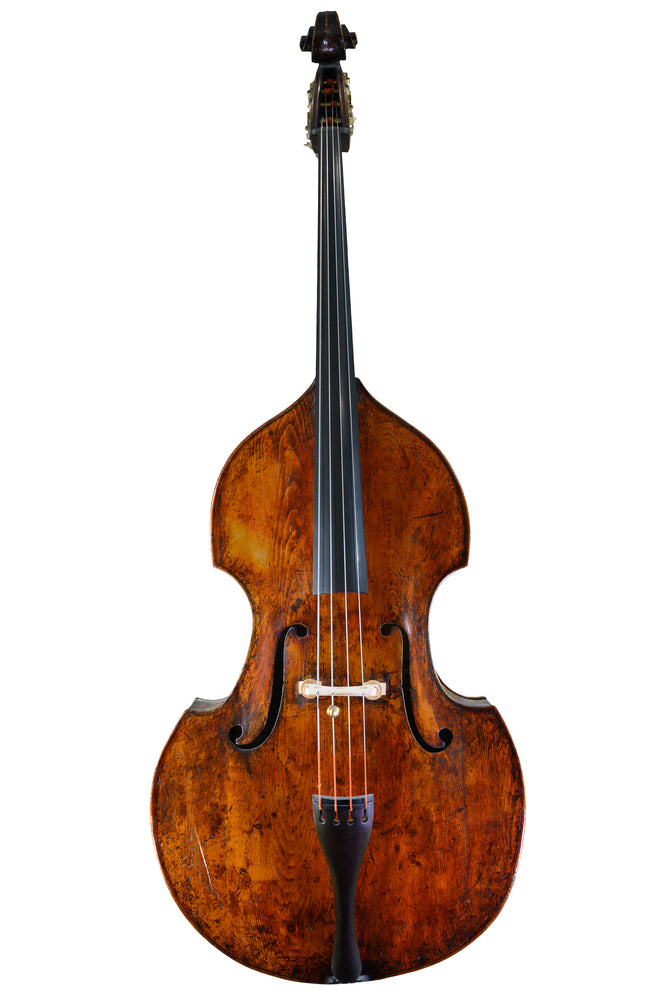
Yes - patience. Our double bass doesn't bear a makers label or
date - so an attempt at trying to place its physical and stylistic
features into some sort of regional and historical context is all
the more relevant. The period that we are actually talking about
is the transition from Late Renaissance to Early Baroque. It's
an incredibly creative period for music, orchestration and instrumental
experimentation and development.
Martinus Kaiser (1642 - 1695) is considered to be the founder
of the craft of string instrument making in Venice. It was however
Kaiser's peer and son in law - Matteo Goffriller (1659 - 1742)
who arrived in Venice in 1685 at the age of 26 that is rightfully
considered the founder of the classical Venetian school of violin
making.
On page 101 of the highly researched and sumptuously
produced volume - Violin and Lute Makers of Venice 1640 - 1760
by Stefano Pio (Published - Venice Research 2004) Pio succinctly
sums up my brief historical assessment as follows - "The
elements that determined his success were his genius associated
with the musical environment of the time. For more than twenty
years, from 1690 - 1715, he (with his co-workers) was the principal
Venetian source of new string instruments. His production, which
at the time was unique for its innovation and high quality, directly
influenced all later Venetian violin makers. In Goffriller's
work we also see the melding of the diverse experiences of earlier
Venetian violin makers, which were re-elaborated in the light
of the new instrumental needs that developed at the end of the
seventeen century."
If you take a look at the pictures of the instrument
before it was restored - you will see that it was delivered to
The Shoppe covered in years of dust and grime and in an extremely
poor condition. Just so that you know exactly how poor the condition
was - the entire "rebuild" consumed self employed restorer Jeroen
Bruynooghe more than 500 hours of his time. Regarding the restoration
Jeroen commented - "Obviously when one has spent such a large
amount of time and effort on the one instrument you just can't
help notice all the details both inside and out." It is really
thanks to Jeroen's observations that our original thoughts of very
early Goffriller bottego (shop) have been revised to something
even earlier - something even more special and rare.
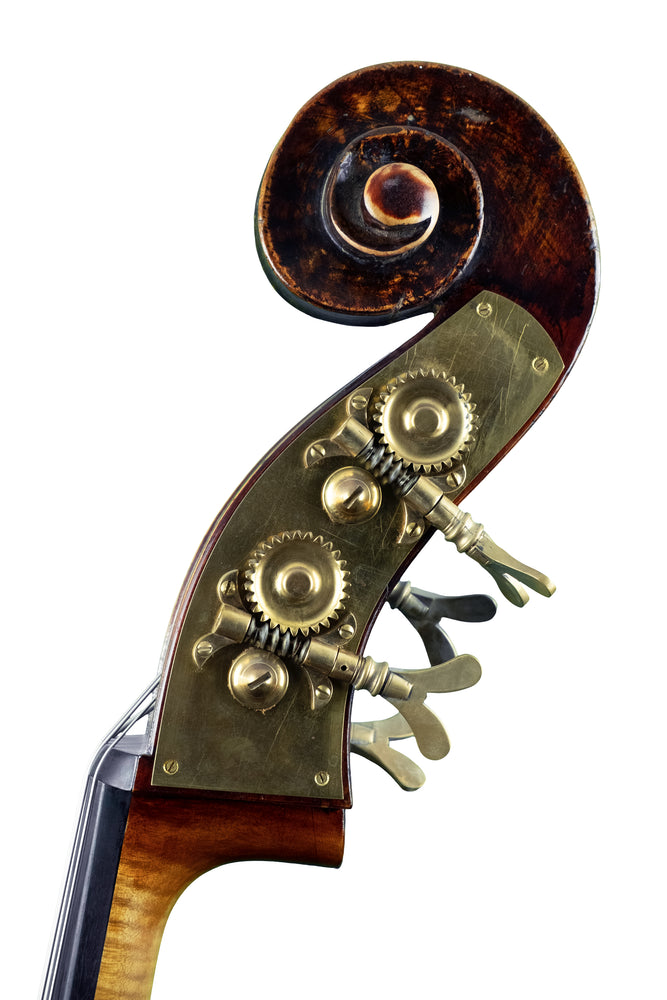
One of the first jobs that Jeroen undertook
was to restore the peg box. It really was only held together
by a brass plate on the bass side. Once again if you look at
the pre-restoration photos you will see the sort of challenges
that faced Jeroen. Jeroen - "When
I took the brass plate off - the peg box just fell apart in my
hands."
"There were so many holes and old bushings
in the pegbox - I'm pretty positive that it was originally made
as a five or six stringed instrument."
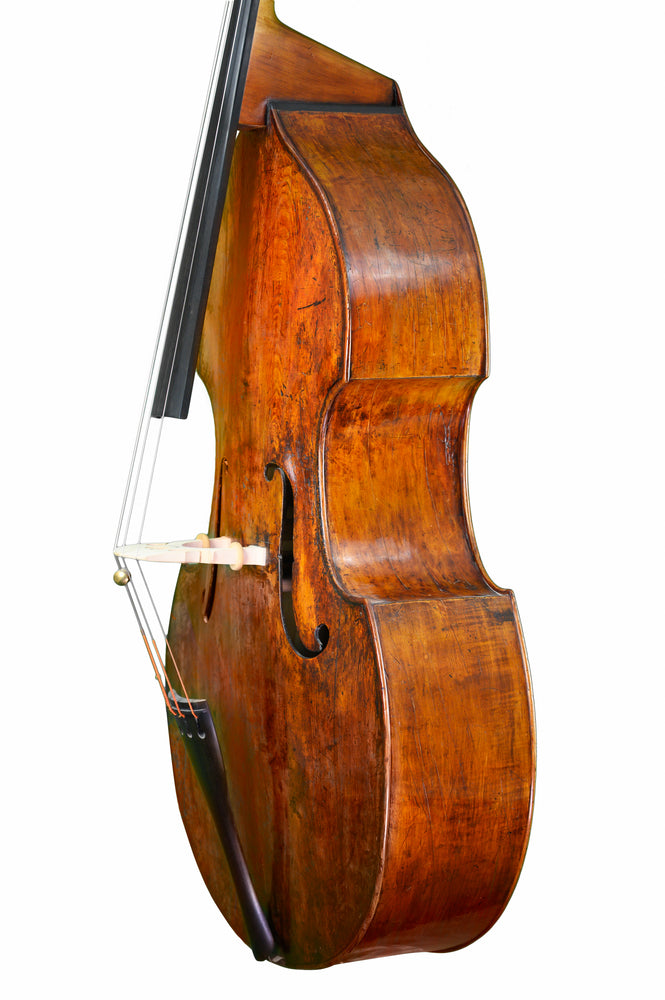
Jeroen seemed to think so. "The distance
between the two F's is relatively wide in comparison to the width
of the centre bouts. In proportion to the dimensions of the whole
body the depth of the same C-bouts is incredibly generous and
open in form."
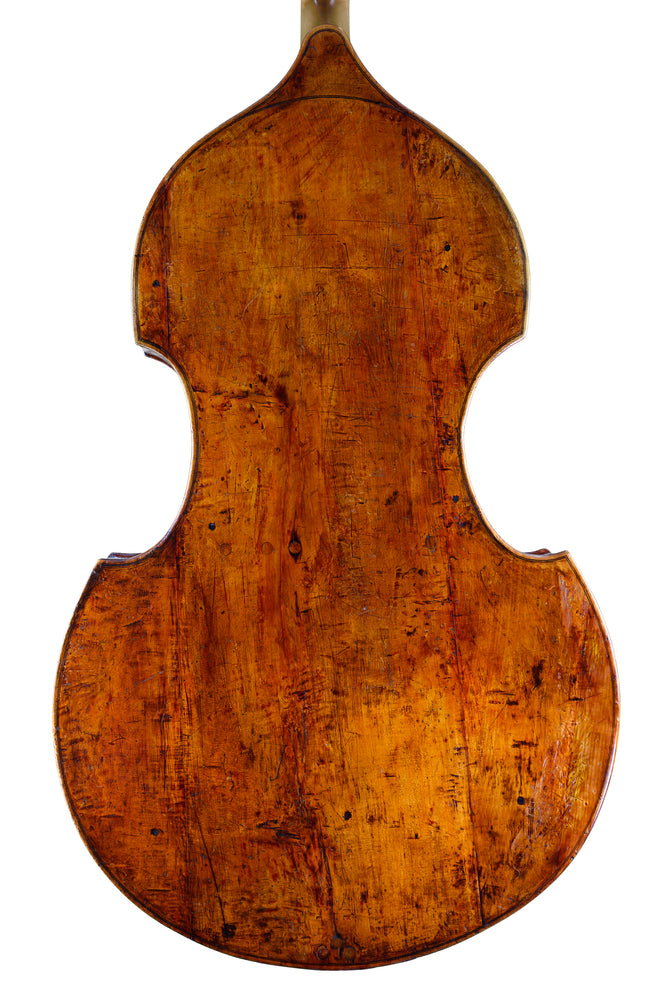
Yes. While working on both front and back Jeroen
commented. "I
think that the inlaid purfilling has been put in at a later date.
If you take a look to the inside of the purfilling there are the
remnants of a different purfilling. It is not an actual inlay -
it is a simple double etched ink-line. Most of the outer line has
been obliterated by the later purfilling but if you take a look
at the back - on the treble side bottom corner there is a really
clear section. You can see that the two etched lines are 2.8mm
apart and the outer line is 11mm in from the outer edge of the
plate. That's a very long way in from the edge. It's exactly the
style of decoration that they use to do on viols and violone."
The visible etching on the back lower corners and around the C-bouts
suggests that they are pretty well much as they were made. Tracing
upwards from the upper corner blocks - the double etched lines
draw closer towards the edge to such an extent that the inner line
disappears altogether - re-entering approximately 14cm or so higher
up - just below where the later purfilling divides to go around
the back button. On the lower bouts - it is not quite so easy to
trace the lines downward - however if you look hard enough it is
clear that they also draw closer to the edge and disappear for
about 14cm.
It suggests that the upper bouts were slightly wider and a tad
squarer than they are now. The lower bouts would also have been
fuller in profile.
We have already calculated the distance from the original edge
to the inner etched line was approximately 13.8mm. If you add this
amount to the points where the inner etched line bisects the current
edge you get a pretty good idea of the original profile.
Yes - the long looping back button is something that harks back
to violone construction when the neck would have sat on the top
of the block.
Yes. Having said that it's probably best to start by saying that
the bottom block was the original and most unusually - it was made
from oak. The upper block on the other hand was made of spruce
and put in some time later. It's not quite clear why the original
top block needed replacing. There was quite a bit of worm damage
to the back of the instrument so it is quite possible that the
block was also damaged - although this seems doubtful as worms
tend to prefer softer species of timber. What is really interesting
is the way part of the old top block was incorporated into the
new block. The luthier cut a trapezoid (12/10mm at front - 18/15
mm at back) type section off from the top of the original oak block
and affixed it to the top of the new spruce block. The method must
have provided them with some sort of time advantage. It is possible
that they didn't want to face the challenge of ungluing the original
joint. Whatever the reason - the neck with its violone style assembly
was reinstated intact. If you take a look at the picture of the
assembly you will see that three wooden pins helped secure the
butt joint firmly together.
No not necessarily - it only confirms that any renewals of the
neck adopted the same method of fitting.
Many viol (treble, tenor and bass) and lira
(da braccio and da gamba) and viola (da braccio, lira and perfetta)
type instruments of the 16th and 17th century had back to back
C type sound holes. On some instrument a wiggle or large outer
nick appeared in the middle of the C - making the bass C look
more like a figure 3 and the treble side look more like an inverted
three. On other instruments the C's became much straighter with
only a suggestion of the former C shapes. On some instruments
a more classic F shape began to appear with the introduction
of a second inner nick. Jeroen - "Yes
- the slightly inward swinging F's with their tear-drop style of
upper lobe and the straight ending wings are strong evidence that
this is indeed one of those transitional type instruments. You
could say a double bass right in the throws of evolution."
In order to compile this short review there has been
a great deal of head scratching and a serious amount of searching
through the reference books in our library. The simple fact is
- there are very few stringed instruments that have survived three
and a half centuries plus with which to compare it to.
Yes. The volume entitled European & American
Musical Instruments by Anthony Baines (Published 1983 by Chancellor
Press - ISBN 0 907486 28 2) is particularly interesting for showing
the wide variety of instrumental forms and shapes being produced
between the sixteenth and seventeenth centuries. Of special mention
are illustrations No 64 - a violone by Ventura Linarol 1585,
No 86 - described as a bass viol by Gioanbattista Ciciliano,
Venice, 16th century and No 87 - a tenor viol by Francesco Linarol,
Venice circa 1540. Interestingly enough instrument No 86 is pictured
again - this time in full colour and in a much larger format
- in the book Musical Instruments in Art and History by Roger
Bragard and Ferdinand J. De Hen (Published 1968 by Barrrie and
Rockliff). In this volume it is described as a viola bastarda
from the year 1660 and by the Venetian maker Antonio Ciciliano
- obviously a relative of Gioanbattista Ciciliano. The Antonio
Ciciliano is definitely the more probable of the two attributions.
The interesting thing about these three instruments is that all
feature four complete corners, six strings, wide central bouts,
arc like upper corners, etched purfilling and C evolved sound holes.
In other words they all display the same fundamental characteristics
as our double bass.
There are obviously modifications - but basically you could say
yes.
Yes. The features just mentioned all strongly support this theory.
Yes.
Yes - Looking at the Double Bass (First published in 1961 by the
author) also contains a couple of very interesting images. In the
section on Italian instruments - on page 115 -there is a six stringed
instrument that is described as a 17th century violone. Unfortunately
there isn't an attribution but in terms of its model and form -
even down to the cut and positioning of the F holes - it is stylistically
very similar to our example.
The other example that displays remarkably
similar making characteristics to our instrument can be found
on page 111. The five string violone is described as being by
the mid 17th century Venetian instrument maker Zuane Rechaldini
(1621 - 1697). Interestingly - the exact same instrument along
with a second instrument is featured in the Pio book Violin and
Lute Maker of Venice already mentioned. In the volume Pio devotes
an entire chapter to Zuanne and his family members. He writes
- "Zuanne Recaldini concentrated his production
on larger instruments such as violone or viola bassa. The store
sign of his botteqa, al Basso, evidenced his legacy."
The style of work, the choice of wood and the dates do fit together
very well - so we would have to say that it's not an unreasonable
attribution. The only problem is that the two featured in the Pio
book are seemingly the only known examples available with which
to make a comparison. On the basis that the F's are more classically
developed than our instrument it is difficult to apply the attribution
with sufficient certainty.
Yes - it is possible but then again we need to consider that there
were plenty of other instrument makers in Venice at this time.
In our library we are fortunate enough to have
an exhibition catalogue by Marco Tiella and Luca Primon entitled "Catalogo degli strumenti
dell'Istituto della Pietà Venezia". The exhibition
was in homage to the greatest master of the Italian concerto -
the Venetian - Antonio Vivaldi (1678 - 1741) and timed to coincide
with the 250th anniversary of his death. In 1703 Vivaldi was appointed
violin teacher at The Ospedale della Pietà as the building
was then named. The Ospedale was one of the largest orphanages
in Venice that offered musical training to talented girls. When
Vivaldi rose to the rank of resident composer and director of the
orchestra, the quality of the concerts given quickly made the orchestra
famous and the orphanage developed more into a fully fledged music
school to which court musicians from neighbouring states were sent.
The exhibition held between 1990 and 1991 displayed many of the
fine instruments that were actually used in Vivaldi's orchestra
at the institution. On pages 69 -71 there is a double bass by the
Venetian maker Pietro Caspan. The instrument is in an unmodernized
and unrestored condition and bears an original pencil inscription
on the back - IO: PIETRO CASPAN / IN VENETIA / 1665.
There are of course lots of interesting things
about this instrument. For this review however the first most
important thing to note is that it was made as a three string
instrument. The second most important thing is that the instrument
follows the classic Brecian model of violin outline, flat back
with upper bevel and deep ribs - that was first conceived by
Gasparo da Salò (1540 - 1609)
possibly as early as circa 1580.
The Caspan bass is incredibly important for it is evidence that
a true double bass was made in Venice in 1665.
No. The model, stylistic features and the proficiency of the making
strongly suggest that Caspan was a bass specialist and that he'd
made a number of instruments prior to this one.
It is covered in a decent quality red-brown varnish of good depth
and texture.
The Caspan bass is yet again incredibly important - this time
because it establishes the fact that significant advancements in
varnish quality, application and aesthetics in general had been
made in Venice by the year 1665.
Also known as Giovanni Pietro Caspani. According
to the Universal Dictionary of Violin and Bow Makers by William
Henley (Published 1973 by Amati Publishing Ltd) Caspan worked
in Venice between 1650 and 1670 and produced upwards of 200 instruments
of "considerable
versatility and talent". Karl Jalovec Italian Violin Makers
(Anglo-Italian Publications Ltd - 1964.) writes - "He was
a pupil of the Amati brothers and worked well in their manner".
According to Dwane Rosengard in his book Contrabassi Cremonesi
(Published by Editrice Turris - 1992. ISBN 88-7929-073-8) as the
demand for a fuller and deeper sound increased many of the larger
violone were adapted and altered to three strings within a few
decades of having been constructed. With the shop of Matteo Goffriller
already highly productive between 1690 and 1710 and a number of
other makers involved in the production and sales of violins it
is quite feasible that the adaptions previously mentioned to the
model and pufilling also took place at this time.
Yes - it is possible. Whenever it was done - you have to admit
it is pretty nice.
The fact that the heal and top of the neck are covered in exactly
the same varnish type as the body of the instrument - does suggest
that the neck was already in place prior to the varnish upgrade.
The old fingerboard.
At some stage of its life it was widened right the way along its
length by a strip of stained rosewood. Incredulously the strip
has been fitted to the centre of the board. That means truing up
four long edges prior to gluing and clamping.
Well - the obvious answer is that a wider board was required.
The most probable time for this would have been when the instrument
was converted from three to four strings. If a new blank of ebony
wasn't available at the time - it would appear that the restorer
just decided to make do with the old board. But what a lot of work!
No. Having said that - one bass restorer that we know is considering
recycling old fingerboards. With good ebony in such short supply
and on the verge of being a prohibitively priced commodity - he
reckons that joining two thin fingerboards together to make one
useable one is not that far off.
Yes indeed.
Well for a start - it is incredibly thin and on the lower positions
deep ruts have been worn into the ebony by the strings.
Plenty of use - plenty of playing.
They are the sort of markings that dealers put on instruments
to remind themselves when they bought an instrument and from whom
they purchased it. We know this for sure - because we do something
similar ourselves.
Yes incredible as this may seems - it is true.
Well I could - but I won't. The review is already way too long
and I'm quite sure that if you take a look at the pictures of the
restoration work and read the short captions that are immediately
below them you will get a much better idea of what was necessary.
Yes - the fact that the front is made from four pieces of timber
and that the back is made from three.
Most double bass makers tend to use what wood they have in stock
or what they can find available. The wood for the back and ribs
of this instrument appear to be made from some sort of fruit wood.
If it is pear - which we suspect it is - the tree grows very slowly
and to relatively small dimensions. Consequently it would have
been difficult to find pieces large enough from which to construct
a two piece back. It is interesting to observe the exact same three
piece construction on the Gasparo Da Salo double bass featured
in the Double Bassist (Orpheus Publications) issue No 39 - Winter
2006. The back and ribs of this instrument are similarly made from
pear.
The type of figure that one can see on a piece
of wood depends on which way the log has been cut and from which
part of the log the timber has been taken. On the table of our
instrument the two types of grain indicate that the selection
of wood was from a board or boards that were cut at a tangent
to the annual growth rings. Due to its gorgeous decorative effect
the part "quarter",
part "slab" sawn timber has often been the cut of choice
for many an Italian maker.
Yes - we find the fact that the nicks on the F-holes are the opposite
way round from what they normally are most intriguing.
Yes.
Yes - there is an identical placement of the nicks on the circa
1720 Matteo Goffriller double bass featured in the Double Bassist
(Orpheus Publications) issue No 36 - Spring 2006.
Yes - the placement can again be seen on the circa 1715 double
bass featured on pages 166-169 of the Stefano Pio book Violin and
Lute Maker of Venice 1640-1760 mentioned earlier.
Yes - some of his cellos and violins incorporate this feature.
Yes - there is a very slight swell to the back.
It really is so slight that it is probably best to describe
it as a "demi-swell".
Well put it this way - we've not seen a profile quite as low as
this one before.
Yes. On the upper treble-side back close to
the lining and the top block there was the semblance of an inscription
in faded black ink. Obviously of considerable age - it is most
unfortunate that it was undecipherable because there is a good
probability that it was placed there by the original maker. A
second inscription is located on the treble-side lower rib near
to the corner block and the back lining. This much more visible
inscription reads "Calow,
Broad Marsh, Not.m (Nottingham) 1924". We also found a third
inscription located on the upper central back. It was from the
same person as the rib inscription and was written in fairly large
hand writing. It read "Repaired by Calow 1924".
The Calow inscription on the lower rib is still
present although partially covered over with new stud work. The
Calow signature on the upper central back and the signature "L'Ancienne" were
removed during the course of the restoration program.
Full, rich, rounded, projecting, clear, brilliant, complex, expressive,
enchanting - are just a few words that come to mind.
Yes definitely.
The origins of the double bass are something that every bass player
will ponder at some point in his or her career. This fascinating
instrument is incredibly important for it helps piece together
the transition from five or six string violone to three string
double bass that was unfolding in Venice during the mid 17th century.
As if all this wasn't enough to digest - the instrument also demonstrates
the stylistic freedom and grace of the Venetian school of making
and simultaneously anticipates the more refined and classic Italian
form that was poised to follow and evolve with the work of Matteo
Goffriller.
The fact that this instrument still exists is absolutely incredible.
LOB (length of back) - 108.2cm (42.60in)
Width across upper bouts - 47.2cm (18.60in)
Width across middle bouts - 33.2cm (13.10in)
Width across lower bouts - 67.1cm (26.46in)
Depth of lower ribs inc both plates - 19.9cm (7.80in)
Body Stop - 55.6cm (21.80in)
String length - 103.6cm (40.80in)
|