
|
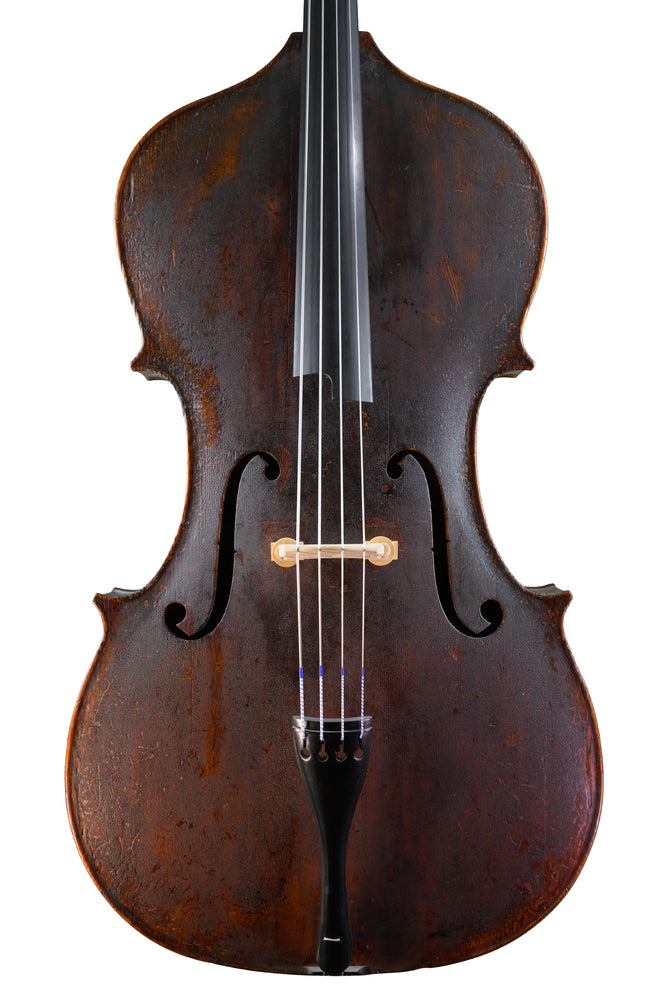
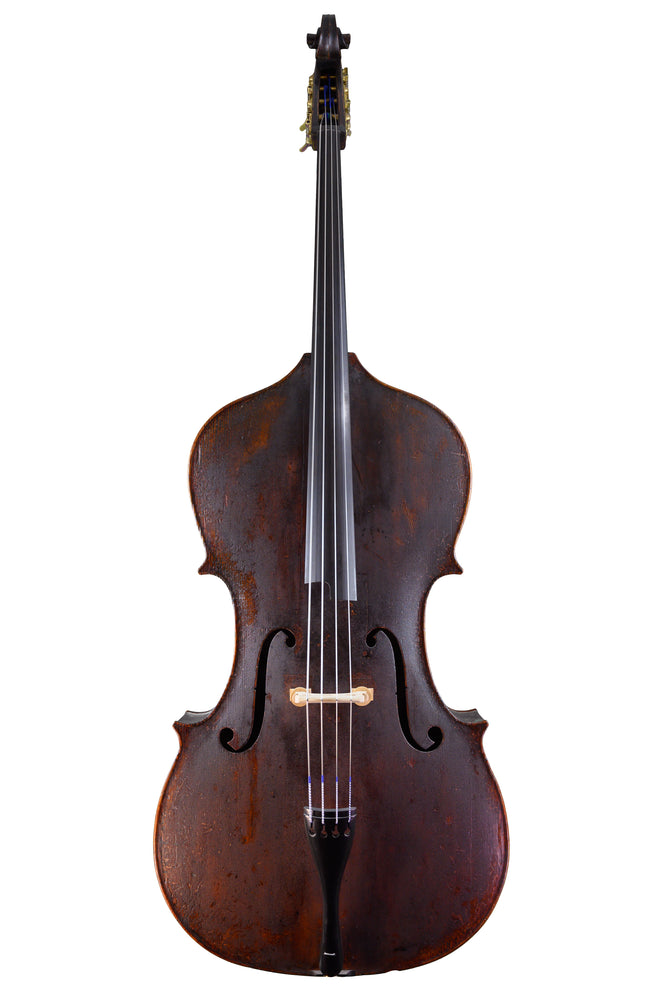
To describe the double bass featured here we
would use the term "extremely-fine".
The instrument is by and labelled in black ink - "Lor° & Tom° Carcassi
in Firenze nell anno 1752 all insegnadel Giglio".
In this case the term can be used to describe the quality of the
making, the overall condition of the instrument and also the tonal
qualities of the instrument.
To find any Italian double bass from the mid 18th century has
always been something quite elusive but to actually come across
an instrument by the Carcassi Brothers has to be even more elusive
than being offered the principal double bass position in the Berlin
Philharmonic Orchestra.
Yes - the Brothers were excellent makers and good examples of
their work are highly prized by both musicians and collectors.
Instruments can exchange hands for considerable sums of money.
The beautiful and carefully crafted book -
Four Centuries Of Violin Making by Tim Ingles published by Cozio
Publishing in 2006 (ISBN 0-9764431-1-2) in collaboration with
the London auction house Sotheby's - features many of the fine
instruments from the past forty years of their auctions. In the
volume the importance of the Carcassi Brothers is underlined
by the fact that a total of four different instruments are featured
over no less than ten pages of colour plates that reproduce the
quality of the instruments at the very highest level. At the
top of page 115 Ingles succinctly summarises the Brothers work
as follows; "Lorenzo & Tomaso Carcassi
(fl Florence, c1750-1780) - The Brothers Lorenzo and Tomaso Carcassi
were probably pupils of G.B. Gabbrielli, who was the leading violin
maker in Florence in the mid-18th century. As was the case in England
at that time, the predominant influence among the Florentine makers
was Jacob Stainer. This was possibly due to the ascendancy of the
Austrian Habsburgs as Grand Dukes of Tuscany. The instruments of
the Brothers Carcassi successfully combine a sometimes exaggerated
but elegant Stainer-esque F-hole with an attractive and usually
golden Italianate varnish. Although the Brothers occasionally worked
individually, the majority of their work bears their joint label."
|
On the instruments that are made and labelled
by Tommaso - his name is clearly spelt with a double "m" - as Tommaso.
Indeed in all of Sotheby's past and present catalogues they give
the double "m" spelling - as Tommaso for the maker. The
only other reference work within our own library of books that
uses the same spelling as Four Centuries of Violin Making is the
Dictionnaire Universel des Luthiers by René Vannes (3rd
edition published 1975 in Brussels by Les Amis de la Musique - ASIN
BOOOOE8V6D). What is bizarre about the Vannes is the fact that
immediately opposite the text is a facsimile label showing the
name "Tommaso Carcassi" spelt with the double "m".
Obviously this is quite puzzling to say the least and taking up
a lot more time than it should.
I e-mailed Mr Ingles at Sotheby's to see if
he could clear things up. This was his reply; "I think I
was probably guided by Charles'(Beare) article in Grove (1980
edition) which has one m. But if you have an original label with
two, then I would be happy to go with that. To be honest spelling
was not as rigid then as it is now, as we see with the Ruggieri
/ Rugieri / Rugeri thing!"
In terms of violin making Jacob Stainer (ca.1617 - 1683) is recognized
as an incredibly important maker. His instruments use to command
higher prices than master Cremonese instruments and his work had
a major influence on luthiers right across Europe. His instruments
were sort after and used by the top musicians of the day and most
unusually for a violin maker - he achieved fame during his lifetime.
Today Stainer is widely considered the finest maker outside of
Italy.
His making techniques and processes were distinctly
Italian. Plausible reasoning suggests that his teacher was Nicoló Amati
(1596-1684).
The following make interesting reading;
- Jakob Stainer Leben und Werk des Tiroler Meister
1617-1683 by Walter Senn and Karl Roy (Published by Verlag E.
Bochinsky, Frankfurt Main 1986. ISBN 3923639694, 9783923639694).
- Jacobus Stainer & 18th Century Violin Masters Exhibition
Catalogue. The exhibition was held from Oct 26th 1981 - Jan
29th 1982 and was a collaborative effort between Jacques Francais,
the Museum of the Performing Arts at Lincoln Centre and the Austrian
Institute.
- The Strad March 2010 (Published by Newsquest Specialist
Media Ltd). Cover article entitled "Think Big" by Darren
Freeman.
- The Strad April 1990 (Published by Orpheus Publications
Ltd). Article entitled "A Violin by Jacobus Stainer 1679" by
Roger Hargrave.
Instrument identification is all about comparison. When you look
at this instrument and compare it to the instruments in the Four
Centuries of Violin Making book and to other examples of the makers
work in other reference books and catalogues - it just looks exactly
like a large Carcassi violin or viola. You see all the same features
and makers characteristics that are present in the violins. The
consistency in the making is absolutely fabulous to see.
Yes as follows;
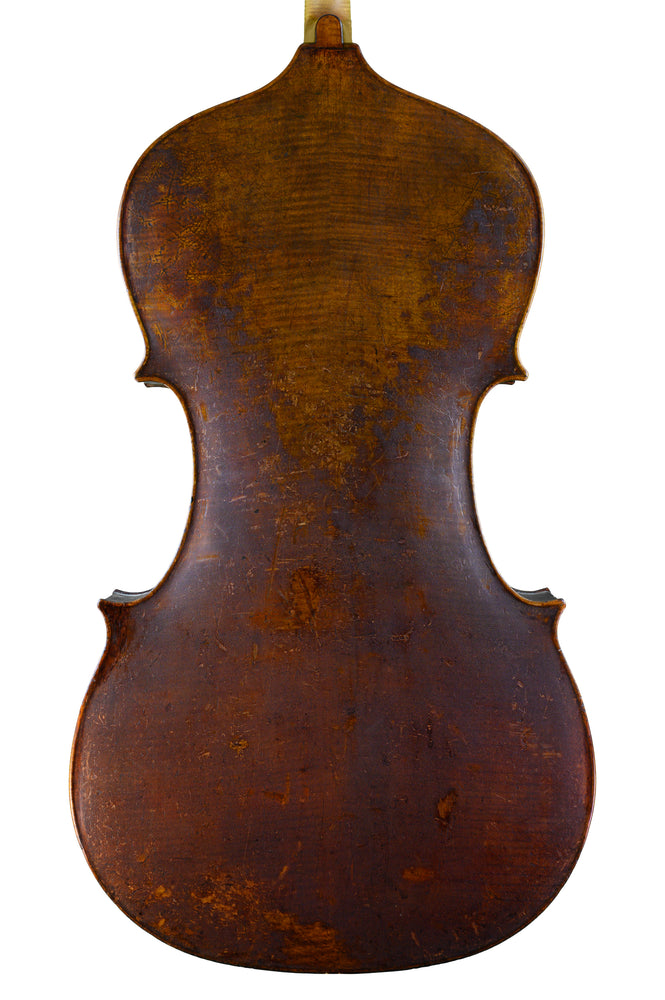
- The model: As previously mentioned the model
follows the form and outline of a violin. Remarkably and strongly
supporting the fact that the instrument was made by true violin
makers from the period - the swell back is devoid of any upper
incline or angle break.
- The table arching: As with the better examples
of the Brothers work the arching is "moderately" arched
in the Stainer style. At the margins the arching cleverly blend
into an edge work of the utmost subtlety.
- The outer workmanship: Is very neat and tidy. When viewed from
the front there is a slight asymmetrical appearance that strongly
supports the fact that the Brothers used an inside mould to make
their instruments.
- The purfilling: Is very much in the style
of Stainer. It is meticulously neat and accurate and positioned
very close to the edge. At the corners the purfilling forms short
symmetrical points that are angled towards the middle of the
corners. On both plates the points extend right to the outer
margins of the plate. On the back the points seem marginally
longer than those on the front. The illusion is more apparent
on the back of the Brothers work and is presumably due to a combination
of the greater difficulty of cutting the point channel with a
knife into the hard maple and less wear.
- The sound-holes: Are beautifully conceived in the Stainer form.
In terms of their execution they are perfectly positioned, perfectly
cut and perfectly finished.
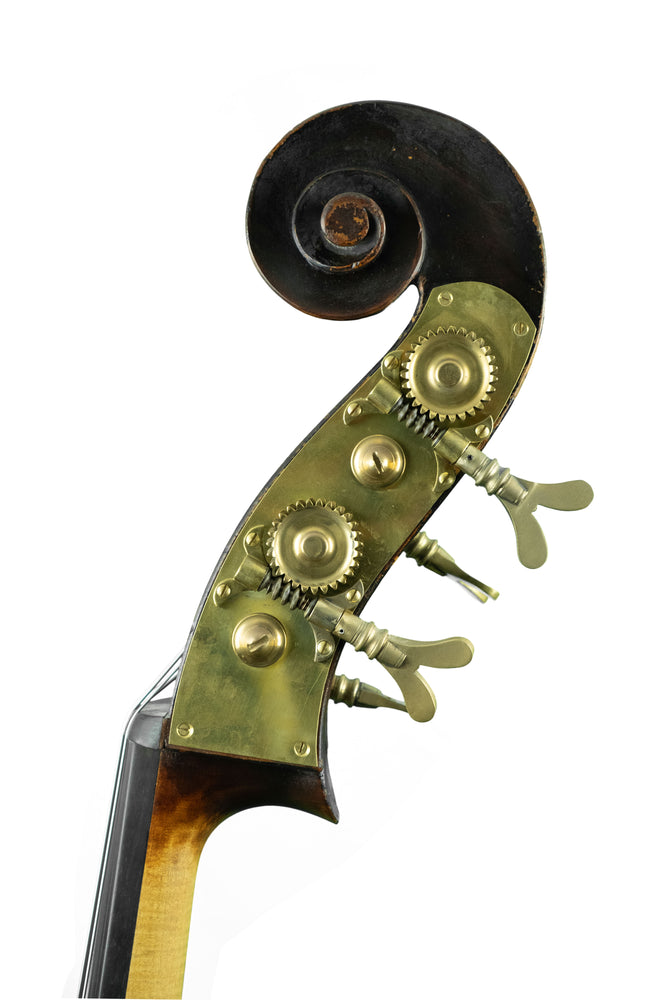
- The scroll: Is neatly carved and beautifully proportioned.
- The timber: In general the Brothers used well selected straight
even-grained spruce and maple that was handsomely figured. On larger
instruments many makers chose to use lesser quality timber. On
this double bass however we see that the Brothers have used a wood
selection that is consistent with their smaller instruments.
- The inner workmanship: Is exceptionally neat.
The following reference books and catalogues show
absolutely classic examples of the Brothers work;
- The Cooper Collection - Volume 2 by Albert W.Cooper (Published
by Ashford Publications 1998. ISBN 0 9528478 1 7) Pages 28 - 33.
Violin circa 1750 by Brothers. J & A Beare certificate 1947.
- Sotheby's 14/06/90 - lot 12. Violin circa 1785 by Brothers (Full
colour front and back views). Hill certificate 1979.
- Sotheby's 06/10/09 - lot 62. Viola circa 1760 by Lorenzo (Full
colour front back and scroll views).
- Sotheby's 14/11/85 - lot 68. Violin circa 1760 by Lorenzo (Full
colour front and back views). Hill certificate 1938. D'Attilli
certificate 1978.
- Sotheby's 15/06/89 - lot 28. Violin circa 1750 by Tommaso
(B&W front & back views).
Most typically the Brothers work is covered in a transparent golden-yellow,
amber-yellow coloured varnish over a yellow ground. On these instruments
the attractive, varnish is uniformly applied. Other instruments
exist such as this double bass that feature additional layers of
dark blood-red or dark-brown varnish.
As the varnish dried the surface slightly separated
and became textured with what is termed a "fine-craqueleur".
Over many years these outer layers have oxidised and further
darkened.
Over many, many years of usage the upper layers of varnish have
worn slowly and naturally due to them coming into direct contact
with the human body and of course through them coming into contact
with physical things such as the instrument`s cover and the floor.
Yes indeed. If you take a look at the upper back the darker layer
has been worn completely away to reveal the splendid hues and transparency
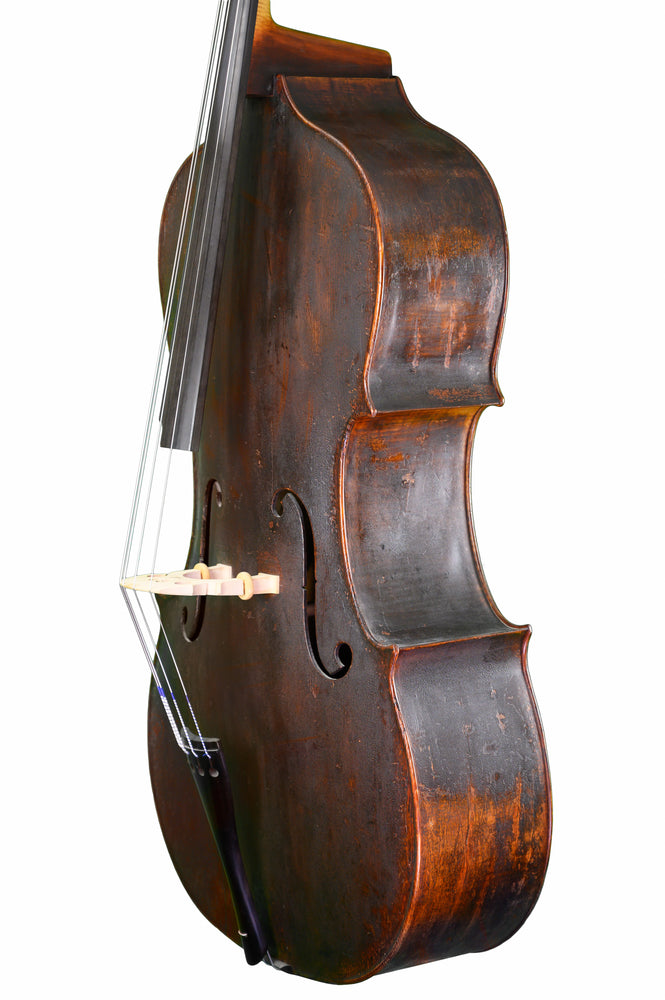
of the lower layers of the varnish. Other areas where natural contact
points reveal the lower layers of the varnish to a larger degree
are on the upper shoulders and on the middle ribs where the instrument
has been placed down on the floor.
Yes indeed. The instrument is visually a real stunner.
Yes. The Conservatorio "Luigi Cherubini" Collection
in Florence houses a Brothers Carcassi violin dated 1767 which
they described as being "... in a good state of conservation
with moderate signs of use." The instrument is fully pictured
in both colour and in black and white and analysed over four pages
in their catalogue of Bowed Stringed Instruments and Bows (Edited
by Gabriele Rossi Rognoni and published in 2009. ISBN 978-88-8347-476-7).
The analysis on the varnish states "The thick, dark brown
paste varnish speaks to the use of opaque minerals. Although we
cannot overlook the possibility that the darkening was caused by
oxidation - this shade seems original and it also extends over
the purfilling making it less visible."
Yes. A colleague in the trade confirmed that
he once owned an early Brothers Carcassi violin that had a varnish
with a near identical colouration, texture and patination to
this double bass. The authenticity of the instrument was fully
supported by a certificate from the leading violin shop John & Arthur
Bear of London.
Yes - there are two. The first is located on
the treble side upper-back close to the linings. The pencil inscription
simply consists of the date 6/10 1908 accompanied by an undecipherable
squiggle type signature. The second inscription - Rep W.F. Crines
1939 - was written in large handwriting in blue crayon and located
quite close to the centre joint on the treble side lower-front.
Unfortunately the surname of the inscriber isn't that easy
to decipher - so it could easily be something slightly different.
The inscription on the upper back is still present. The inscription
on the lower table was removed during the work that was required
to make the table less rigid.
The inscription reads - Ex K Hall 10/62 £6/=1
It is the sort of marking that a dealer or violin
proprietor will put onto an instrument to remind himself when he
bought the instrument and from whom he purchased it. We know this
for sure because we do something similar ourselves albeit much
more discreetly. In view of the state of the instrument and the
boldness of the marking one must wonder if the shop owner/restorer
was already resigned to the fact that he might not get round to
doing it up for quite some time!
Yes incredible as it may seem - the dealer has inscribed the name
K. Hall as the vendor and the purchase price of six guineas.
Yes - for a normal working person six guineas was an awful lot
of money. Unfortunately we are unable to provide you with a comparison
as to its buying potential at that time because our own auction
records don't really start until 1977.
Yes - there is a small figure "10" just
below the back button.
Although it is not possible to conclude anything
from the number on its own - the system of branding a number onto
an instrument in this way was usually done to provide identification
or reference to some sort of inventory or collection.
Shortly after posting this review on The Contrabass
Shoppe's website - director Tony Houska received a short e-mail
from one of his former playing colleagues regarding the yellow
crayon inscription on the outside of the treble side middle-bout.
The essential part reads - "K Hall might well be Kneller Hall".
No - for some reason we just
automatically assumed that the instrument must have belonged to
a player. Kneller Hall certainly fits in perfectly with the number
branded just below the back button, to some extent the damage that
was sustained to the instrument and also to the close proximity
of a historically important string musical instrument repair shop
in which we suspect the instrument had been ensconced for such
a long time.
Yes. Instruments in the ownership of Royal Military
often had an extremely "hard life". Any instruments that became damaged
beyond economical repair were often disposed of and simply replaced
by new ones. We are almost certain that the repair shop referred
to in the above paragraph - currently in its fourth generation
of ownership - would have serviced the needs of the Royal Military
School of Music at Kneller Hall.
Yes. The British Army has an incredibly long and
rich history of using military bands to provide moral support for
their fighting forces and to provide support for state and ceremonial
occasions. At one time there was a total of 69 bands in existence.
In 1857 a 'Class of Music' was founded at Kneller Hall near Twickenham
by His Royal Highness Field Marshal the Duke of Cambridge. In 1887
- the Golden Jubilee year of Her Majesty Queen Victoria it was
graciously retitled as the Royal Military School of Music. On 1st
September 1994 the Headquarters of the Corps of Army Music joined
the Royal Military School of Music on the site. Today (August 2011)
the School of Music is still a centre for excellence that plays
a vital role in shaping the attitudes, values and standards of
soldiers wanting to join the Corps of Army Music. For more information
on The Royal Military School of Music please click on the following
link - http://www.army.mod.uk/music/music-school/default.aspx
|
Yes. Many of the military bands were able to acquire
and indeed still have very valuable instruments in their ownership.
For those interested there is a Music Museum at Kneller Hall that
has a collection of musical instruments, music, documents, prints,
manuscripts, paintings and uniforms that show the history of military
music. It is open to the public by appointment.
We have done absolutely everything necessary to put this instrument
into the finest structural and playing condition possible. In total
the work consumed over 480 hrs of our restorer's time. Please take
a look at the pictures of the restoration work and read the short
captions that are immediately underneath. Out of approximately
125 photos taken - the small selection of images that are posted
here should hopefully give you an impression as to the extent and
variety of the work involved. They have also been selected to demonstrate
the high level of skills necessary to complete the project and
bring an unquestionably beautiful instrument back to life.
Thank you for your compliments - they are always welcome. The
work was performed by self-employed luthier Jeroen Bruynooghe who
currently lives in France.
When we purchased the instrument - it still
had its original "fixed-peg" endpin
unit in place. We are not talking about any old endpin unit here
- we are talking about an endpin unit that has been on the instrument
for over a quarter of a millenium.
Yes indeed.
The unit or endpin "peg" as it is
best described - is made from a very dense type of Blackwood
and simply consists of a short non-adjustable steel tip that
projects from the end of a non-adjustable turned peg. When new
the steel tip is likely to have projected by 10mm or so - but
following years and years of use - it has completely worn down
and is now virtually flat with the end of the wooden peg.
Yes indeed. It forms part of the instrument's history.
It was for the tail wire "stop" or "endbutton".
On early instruments such as this - the tail wire or tail gut as
it would have been then - was secured by means of a small round
hard-wood stop as opposed to being secured directly on to the endpin
unit as we do today.
The feature has its origins in viol construction. When these instruments
were held - as they were - either at the shoulder, between the
legs or supported on a cushion - nothing else was necessary. When
instruments started to become larger in size and were required
to rest directly on the floor - the separate fixed-wooden peg was
introduced and used in conjunction with the tail-gut endbutton.
The experience of playing on this Brothers Carcassi double bass
really is something very unique, something very special, something
very, very rewarding indeed. If we did use adjectives such as tonally
rich, clear, refined, projecting, warm, even and articulate - they
will never quite do enough justice in comparison to actually playing
and hearing the instrument yourself.
If you are a player looking for an extremely-fine
concert or solo instrument, an orchestra or a collector with
an eye for a good investment then this immaculately made, superb
looking, superb sounding instrument by Lorenzo & Tommaso
Carcassi ticks all the right boxes for sure.
Historically, visually and aurally this is a jaw-dropingly amazing
instrument.
There you go. It could be yours.
LOB (length of back) - 114.0cm (44.75in)
Width across upper bouts - 52.5cm (20.70in)
Width across middle bouts - 35.7cm (14.10in)
Width across lower bouts - 65.0cm (25.60in)
Depth of lower ribs inc both plates - 20.5cm (8.13in)
Body Stop - 62.9cm (24.75in)
String length - 106.9cm (42.15in)
|