
|
William Fendt was the second son of Bernard Simon Fendt (1801
- 1852). He was born in London in 1832 and died in 1852.
Yes it is.
Yes correct.
According to the beautifully produced and authoritative book The
British Violin published by the British Violin Making Association
in 2000 (ISBN 0 953471 27) - they both died at 7 Smith Street,
Chelsea of consumption. Today we call this deadly disease tuberculosis
or TB.
Yes unfortunately it has - and in a big way too. If William Fendt
had lived to a much greater age there is little doubt that his
name would be as familiar to us as that of his father. Some violin
connoisseurs even put what still exists of his output on the same
level as John Lott Junior.
The Universal Dictionary Of Violin And Bow
Makers by William Henley (Amati Publishing Ltd 1973 Edition)
writes 'Son of Bernard Simon. Born in London, 1833. Died in 19th
year. Pupil of and co-worker with father. Unquestionably a youth
of very remarkable talent. His violins catalogued at £40, give every evidence that the
art was "the passion of his life", and if his life had
been prolonged his name would doubtless have been enrolled on the
most conspicuous line of any monument of fame we may erect in our
mind in honour of genius. His violas and double-basses must not
be regarded as merely "the tuning of his lyre" but rather
as one who has accomplished a perfect technique.'
Agreed.
Endnote Nr 117 on page 112 of The British Violin
records "William
was baptised at St. Matthew's, Bethnal Green, on 27.5.1832".
Yes indeed. In forty years of playing the double bass and dealing
in violins this is the only double bass by William Fendt that director
Anthony Houska has ever seen.
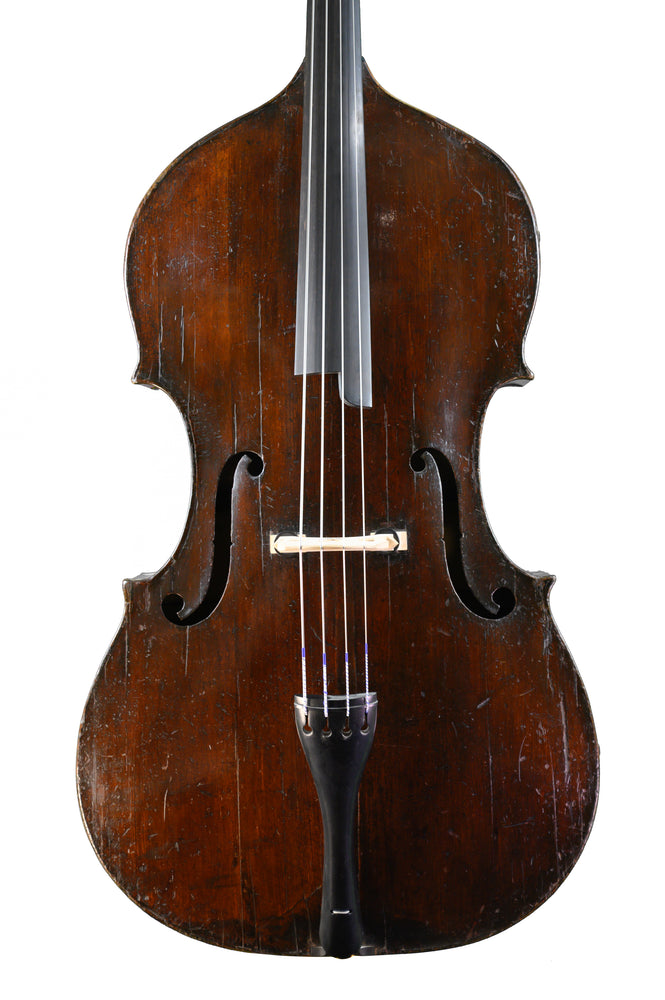
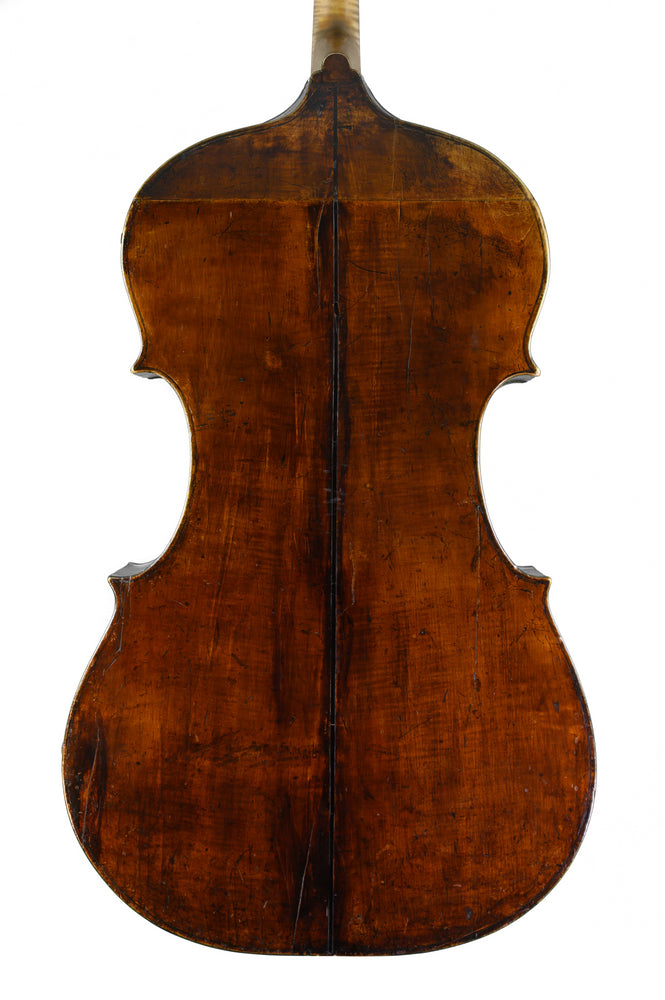
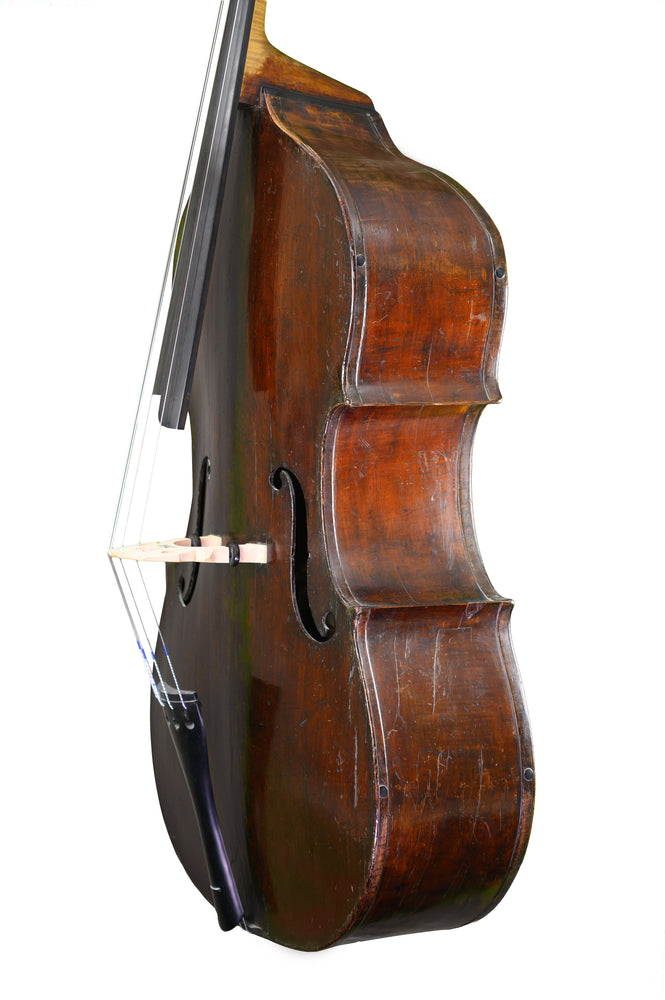
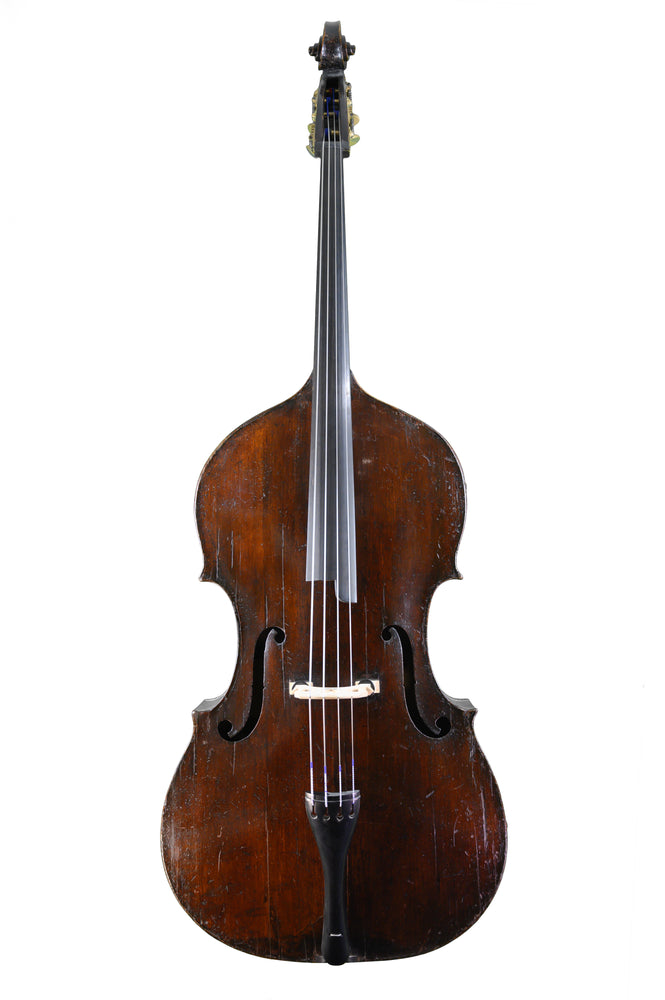
Everything about this instrument is beautifully understated.
The model has measurement that are pretty well perfect, the arching
of the table is pretty well perfect, the proportions and carving
of the scroll are pretty well perfect, the positioning and cut
of the F's are pretty well perfect and the quality and texture
of the beautifully preserved dark orange-brown varnish is absolutely
sublime.
I would compare it to a Masserati GranTurismo.
Because both have an excellent heritage, an understated
grace, and a seductive beauty.
Once again it is an excellent comparison. The William Fendt has
unprecedented levels of both power and tone.
We are talking about huge well-rounded sounds
with rich, deep-dark-colours that are still able to offer projection.
We are talking about a perfect evenness in the levels of sound
and tone right from the low notes of the E-string to the very
top notes on thefingerboard of the G-string. We are talking
about a responsiveness that will flatter every bowing stroke
that you make. In fact we are talking about sounds, feelings
and sensations that are so pleasurable - you may well experience
the hairs on your arms lifting because they've gone all
goose-bumpy. Now that is a great feeling.
Yes. We can trace the instrument back to the
musical instrument auction held at Sotheby's on the 11th June
1996 in which lot 102 was described as 'A DOUBLE BASS - Early
19th Century'. The lot was purchased by Shoppe director Anthony
Houska for Instruments & Bows
- his former trading name.
The instrument was sold on the 25th September 1996 to a player
in the Orchestra of the Royal Opera House, Covent Garden. In March
2008 the instrument was sold via a UK South-coast dealer in association
with a Dutch dealer to a classical player in Holland. Around June
2009 - and only due to an unfortunate change in circumstances -
the instrument was placed back on the market. It was acquired by
a well known Dutch dealer from whom The Contrabass Shoppe purchased
it in May 2011.
After purchase - the player from Covent Garden
wanted a new neck and a new bass bar fitted. The instrument was
taken to the highly experienced bass restorer Roger Dawson based
in Greenwich, London. On opening the instrument a faint maker's
inscription in pencil was found on the upper treble side table
with part of the inscription obscured by old stud work. At the
time of writing this review both player and restorer were kind
enough to reconfirm the presence of the inscription and that it
read "William Fendt Lon....".
Unfortunately no.
Unfortunately not. What we do know is that it is a great shame
that a photographic record was not kept and supplied with the instrument.
The Dutch player had been informed "by specialists" that
the instrument had been made by Bernard Simon Fendt around 1820.
A photographic record would have preserved the true identity of
the instrument. Fortunately for both our knowledge of the double
bass and our heritage The Contrabass Shoppe has now been able to
set the record straight. 
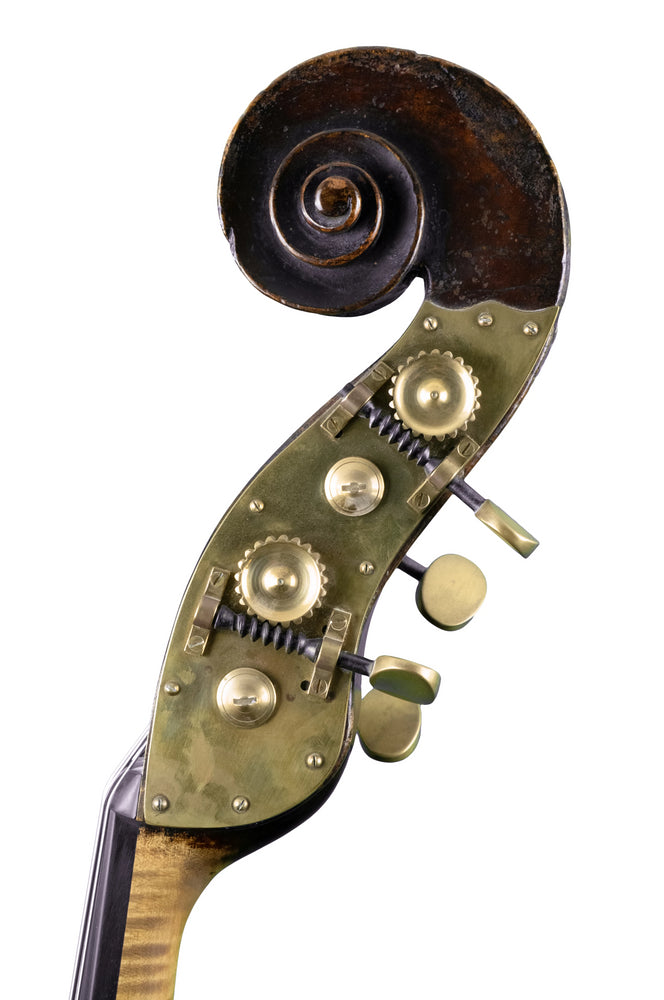
The front and top of the scroll is characterized
by the lack of a central ridge. The smooth scalloped profile
at the front of the scroll flows right over the top of the head
and into the back of the peg-box where if flattens and eventually
terminates in a rounded heel and rounded back button. Stylistically
we can say that the head and indeed the whole instrument are
in the "Brescian" style.
Our bass heritage is blessed with the fact
that many of the great London makers of the 19th century based
their work on the designs and characteristics of Gasparo da Salò (1540-1609) and his
apprentice Giovanni Paolo Maggini (1580-1630/31). Both da Salò and
Maggini lived and worked in the area of Northern Italy known as
Brescia. Their contribution to the development, construction and
advancement of the present day violin family of instruments - in
particularly that of the double bass - was considerable.
It would appear to be a remnant of viol making.
Indeed the book Gasparo Da Salò La Vita E L'Opera 1540-1609
by A.M.Mucchi published by Ulrico Hoepli in 1940 - shows us several
views of a viola da gamba and a double bass with this style of
smooth ridgeless scroll and rounded pegbox.
Yes - the head of the "Ex-Tarisio Violone" by Gasparo
da Salò is essentially in this style. The instrument is
featured on page 27 of The Baroque Double Bass Violone by Alfred
Planyavsky which was published by Scarecrow Press, Inc in 1998
(ISBN 0-8108-3448-0). In addition the fine and rare "Delmas" Maggini
double bass that was sold on the 4th May 2011 by Tarisio the online
auction house - has a scroll that apart from outward projecting
points near the centre of the pegbox profile is fundamentally in
a similar style.
Yes it is. Once again it would appear that
William Fendt was inspired by the work of Gasparo da Salò. If we look at the exquisite
colour photographs of Dragonetti's Gasparo Da Salò bass
- which incidentally are the first colour images to be ever published
- in the highly researched and sumptuously produced volume - Liuteri
Sonadori Venice 1750 - 1870 by Stefano Pio which was published
by Venice Research in 2002 - you will observe a remarkably close
similarity to the whole concept of proportion and design.
Yes we do. It was Dragonetti's involvement in the vibrant musical
scene in England that influenced the demand to play the double
bass and improve playing standards. This in turn fuelled a demand
for both old and new instruments.
According to the book Domenico Dragonetti in England (1794-1846)
by Fiona M. Palmer published by Clarendon Press in 1997 (ISBN 0-19-816591-9)
Dragonetti (1763-1846) first arrived in England in the autumn of
1794. Apart from trips and periods back to Italy and other countries
- England became Dragonetti's home and it was England where he
was buried fifty-two years later.
Yes - it is quite feasible that a young William
Fendt along with his dad had the opportunity to see and examine
some of Dragonetti's instrument collection. Maybe he even saw
the Gasparo da Salò bass
on which Dragonetti played throughout his career. Where ever the
inspiration to make this wonderful instrument came from it is certainly
tragic that William Fendt's mastery and unquestionable skill was
cut short.
In terms of London making - this fine and rare example
of the work of William Fendt really is a King amongst Kings. In
terms of comparing this classic English instrument to the beautifully
understated Maserati GranTurismo - at the very least you'll be
happy to know that if you purchase the William Fendt your insurance
premiums will be much lower than if you spend the money on a Maserati!
LOB (length of back) - 110.7cm (43.60in)
Width across upper bouts - 52.6cm (20.75in)
Width across middle bouts - 37.0cm (14.55in)
Width across lower bouts - 66.0cm (26.00in)
Depth of lower ribs inc both plates - 22.8cm (8.96in)
Body Stop - 60.0cm (23.65in)
String length - 105.7cm (41.65in)
|